


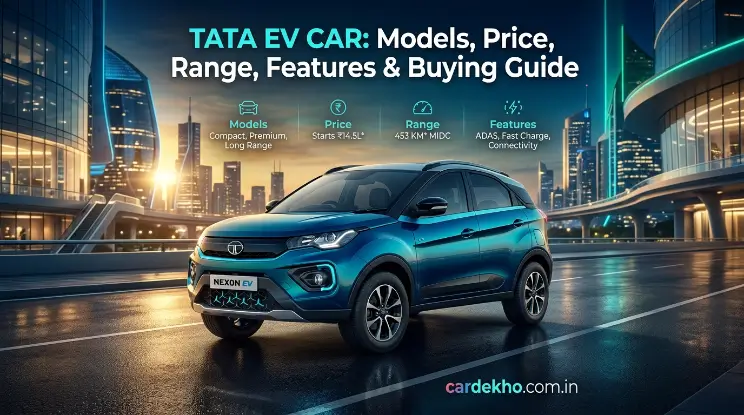
Welcome to CarDekho. A Tata EV car can be an attractive choice for buyers who want lower running costs, quiet performance, and the convenience of charging at home. Tata Motors has built one of India’s broadest electric car portfolios, covering hatchbacks, compact SUVs, premium SUVs, and sedans. Its current Tata. ev range includes the Tiago. Punch. Nexon EV, Curvv.Harrier. EV, Sierra EV, and Tigor EV.
Choosing the right Tata EV car, however, is about more than comparing prices or claimed range. Battery capacity, real-world range, charging access, features, space, and daily driving requirements all matter. This guide explains the current Tata EV lineup, pricing, range, charging, running costs, and which model may suit different types of buyers.
Tata EV Car Models Available in India
Tata’s current electric portfolio covers several price and size categories. The official Tata website lists seven passenger EV models: Harrier. ev, Nexon.Curvv.ev, Punch ev, Tiago ev and Tigor ev.
Tata Tiago EV
The Tata Tiago EV is positioned as an affordable electric hatchback for buyers who mainly drive in cities. It is compact, easy to manoeuvre, and available with different battery configurations.
Tata’s current support information lists 19.2 kWh and 24 kWh battery options, with MIDC P1+P2 ranges of 221 km and 275 km respectively. Its C75 real-world-oriented figures are lower, showing why buyers should not treat the certified figure as a guaranteed daily range.
It is a sensible choice for commuters who want an affordable EV and have convenient home charging.
Tata Punch EV
The Tata Punch EV combines a compact SUV design with an electric powertrain. It is available with 30 kWh and 40 kWh battery packs. Tata lists MIDC P1+P2 ranges of 365–375 km for the 30 kWh version and 468 km for the 40 kWh version.
The Punch. ev is particularly appealing to buyers who want a small footprint without giving up the higher seating position and practicality of an SUV.
Tata Nexon EV
The Tata Nexon EV is one of the most established models in Tata’s electric lineup. It offers a more spacious cabin than the Tiago. ev and is aimed at buyers looking for an electric compact SUV suitable for both city driving and occasional highway travel.
Tata’s published battery and range information includes 30 kWh, 40.5 kWh, and 45 kWh configurations across the Nexon EV range. The 45 kWh version is listed with a 489 km MIDC P1+P2 figure and a C75 range of approximately 350–375 km.
Tata Curvv EV
The Tata Curvv EV adds a more distinctive SUV-coupe design to the lineup. It targets buyers who want a combination of style, cabin technology and longer-range electric driving.
Tata lists 45 kWh and 55 kWh versions, with MIDC P1+P2 ranges of 430 km and 502 km respectively. C75 figures are approximately 330–350 km and 400–425 km.
Tata Harrier EV
The Tata Harrier EV is aimed at buyers who want a larger and more premium electric SUV. Its bigger dimensions, higher equipment level and larger battery options make it more suitable for families and buyers who regularly travel longer distances.
Tata lists 65 kWh and 75 kWh battery configurations. The 75 kWh rear-wheel-drive version has a listed MIDC P1+P2 range of 627 km, while the 75 kWh QWD version is listed at 622 km.
Tata Sierra EV
The Tata Sierra EV brings the familiar Sierra name into Tata’s modern electric portfolio. It is positioned above the smaller SUVs and focuses on space, comfort, technology, and longer-distance usability.
Tata lists 63 kWh and 75 kWh battery options. The 75 kWh version has a published MIDC P1+P2 range of 665 km, while the C75 figure is approximately 510–530 km.
Tata Tigor EV
The Tata Tigor EV is an electric sedan designed primarily around practical urban transportation. Tata currently lists it alongside the rest of its electric passenger-vehicle portfolio.
Its sedan body provides a different alternative to Tata’s many electric SUVs. It can make sense for buyers who prefer a conventional three-box design or require an EV for practical urban use.
Tata EV Car Price in India
The price of a Tata EV car depends on the model, battery capacity, variant, and available offers. Current September 2026 market listings put Tata EV prices at roughly ₹6.99 lakh for the Tiago EV at the lower end and around ₹30.54 lakh for the Harrier EV at the upper end, with several models between them.
Indicative current ex-showroom ranges include:
| Tata EV | Approx. Ex-Showroom Price | Battery / Range Position |
| Tiago EV | ₹6.99–10.09 lakh | Entry-level |
| Punch EV | ₹9.79–12.99 lakh | Compact SUV |
| Tigor EV | ₹12.49–13.75 lakh | Electric sedan |
| Nexon EV | ₹12.49–17.89 lakh | Compact SUV |
| Curvv EV | ₹17.19–19.69 lakh | Premium SUV-coupe |
| Sierra EV | ₹18.79–26.48 lakh | Premium SUV |
| Harrier EV | ₹21.79–30.54 lakh | Large premium SUV |
These figures are indicative market prices and can change with variant revisions, offers, and price updates. Tata’s own website states that its displayed EV prices are ex-showroom and subject to change.
When comparing the Tata EV price in India, do not look only at the starting price. A higher trim may offer a larger battery, better charging capability, and additional features that can make more sense for your usage.
Read Also: Jimny Car: Price, Features, Specifications & Complete Guide
Tata EV Car Range and Battery Options
Battery capacity is one of the most important factors when choosing a Tata EV car. A larger battery generally provides more energy storage, but it can also increase the purchase price and vehicle weight.
Tata’s current published figures range from the Tiago EV’s 19.2 kWh battery to 75 kWh configurations in the Sierra EV and Harrier. ev.
| Model | Battery Options | Published MIDC P1+P2 Range |
| Tiago. ev | 19.2 / 24 kWh | 221 / 275 km |
| Punch. ev | 30 / 40 kWh | 365–375 / 468 km |
| Nexon. ev | 30 / 40.5 / 45 kWh | Up to 489 km |
| Curvv. ev | 45 / 55 kWh | 430 / 502 km |
| Harrier. ev | 65 / 75 kWh | Up to 627 km |
| Sierra. ev | 63 / 75 kWh | Up to 665 km |
These are certified figures, not guarantees of everyday driving distance.
Claimed Range vs Real-World Range
The biggest mistake new EV buyers make is assuming the certified range will always be available in normal driving.
Actual EV range depends on:
- Driving speed
- Air-conditioning use
- Traffic conditions
- Driving style
- Outside temperature
- Passenger and luggage load
- Tyre pressure
- Road conditions
Tata’s own C75 figures provide a useful indication of how certified range can differ from more realistic operating conditions. For example, the 55 kWh Curvv EV is listed at 502 km under MIDC P1+P2 but around 400–425 km under C75.
Which Tata EV Offers the Best Range?
Based on Tata’s current published figures, the Sierra EV has the highest listed MIDC P1+P2 range at up to 665 km, followed by the Harrier. ev at up to 627 km.
However, the best range is not automatically the best value. A city commuter who travels 30–50 km per day may not benefit enough from a very large battery to justify the additional purchase price.
Tata EV Charging Time and Charging Cost
Charging is the biggest lifestyle difference between an electric car and a petrol vehicle. Instead of visiting a fuel station, EV owners can often start each day with a charged battery by plugging in at home.
Home Charging
Home charging is particularly useful for people with a private parking space and access to electricity.
An overnight charging routine can be convenient because the vehicle can charge while it is parked. The exact charging time depends on the battery size, charger output, starting state of charge, and vehicle configuration.
Before buying a Tata EV, check whether your parking location can safely support the required charging equipment.
DC Fast Charging
DC fast charging is more important for highway journeys and situations where you need to add significant range quickly.
Charging speed is not constant throughout the entire charging session. It can reduce as the battery approaches a high state of charge. Battery temperature and charger capacity can also affect the actual result.
For long trips, plan charging stops around your route rather than waiting until the battery becomes critically low.
Tata EV Charging Cost
A simple way to estimate home charging cost is:
Charging cost = Electricity consumed × Electricity tariff
For example, if an EV uses 40 kWh of electricity and your effective tariff is ₹8 per kWh, the basic energy cost would be approximately ₹320 before considering charging losses.
Your actual cost can be different because electricity tariffs vary by location and charging efficiency is not 100%.
Tata EV Features and Driving Experience
Modern Tata EVs offer considerably more than an electric powertrain. Depending on the model and variant, buyers can find features covering infotainment, connected-car technology, safety, comfort, and driving assistance.
Common areas to compare include:
- Infotainment and smartphone connectivity
- Connected-car features
- Safety equipment
- Regenerative braking
- Drive modes
- Automatic driving experience
- Cabin comfort
- Boot and storage space
The Punch. ev, for example, is offered with 30 kWh and 40 kWh battery options, permanent-magnet synchronous motors, and multiple drive modes. Tata also lists multi-level regenerative braking on relevant versions.
The driving experience is one of the strongest advantages of an EV. Electric motors deliver torque immediately, while the absence of a conventional multi-speed gearbox makes acceleration smooth and predictable.
However, equipment differs significantly by variant. Buyers should compare the exact version they intend to purchase rather than assuming every model includes every feature.
Tata EV Running Cost and Maintenance
One of the main reasons people consider a Tata EV car is its potential for lower running costs.
An EV does not require conventional engine oil changes and has fewer mechanical components associated with an internal-combustion engine. Regenerative braking can also reduce reliance on the friction brakes in many driving situations.
The biggest financial advantage usually appears when the owner can charge regularly at home. Public charging can be more expensive depending on the operator and location.
Battery warranty is another important consideration. Tata currently provides lifetime HV battery warranty terms on certain models for the first registration, subject to the stated conditions. For example, the published policy covers the Sierra EV and Harrier. For the defined lifetime period, several other models have specified eight-year/160,000 km terms.
Always read the exact warranty terms for the variant you purchase.
Which Tata EV Car Should You Buy?
There is no single best Tata EV car for every buyer. The right model depends on budget, driving distance, family size, and charging access.
Best Tata EV for City Driving
For primarily urban driving, the Tiago. ev is the most straightforward option when purchase price and compact dimensions are priorities.
The Punch. ev is a stronger choice if you want a small SUV shape, additional cabin practicality, and a larger battery option.
Best Tata EV for Families
The Punch. ev and Nexon. ev are logical starting points for families.
The Nexon. ev offers a more substantial compact-SUV package, while the Punch. ev can be attractive for buyers who want a smaller vehicle that remains practical for everyday family use.
Best Tata EV for Long-Distance Driving
For regular highway travel, larger-battery models such as the Curvv EV, Harrier EV, and Sierra EV.EVs provide greater certified range than the smaller Tata EVs.
However, range should be considered alongside fast-charging availability and your usual routes. A vehicle with a large battery is most useful when the rest of the charging ecosystem supports your travel pattern.
Best Tata EV for Budget Buyers
The Tiago. ev is the natural starting point for buyers who want the lowest entry price into Tata’s passenger EV range.
The Punch. ev can make more sense if you can spend more and want the practicality of a compact SUV.
Best Tata EV for Premium Buyers
The Harrier and Sierra EV are positioned toward buyers seeking a larger, more premium electric SUV.
The Curvv. EV sits between the smaller SUV offerings and the larger premium models, making it an interesting option for buyers who prioritise styling and a longer-range package without moving to the largest SUV category.
Tata EV Car vs Petrol Car
Choosing between a Tata EV car and a petrol vehicle depends heavily on how and where you drive.
| Factor | Tata EV | Petrol Car |
| Running cost | Usually lower with home charging | Usually higher |
| Maintenance | Generally simpler | More mechanical servicing |
| Refuelling/charging | Slower but can be done at home | Fast refuelling |
| City driving | Excellent | Good |
| Long trips | Requires charging planning | Usually simpler |
| Upfront cost | Can be higher | More options at lower prices |
For daily city driving, an EV can be particularly convenient when home charging is available. For buyers who frequently make unpredictable long-distance journeys through areas with limited charging infrastructure, a petrol vehicle can still offer greater flexibility.
The best comparison is therefore based on total ownership cost and usage rather than purchase price alone.
What to Check Before Buying a Tata EV
Before buying a Tata EV car, work through this checklist:
- Daily driving distance: Estimate your normal weekly usage.
- Home charging: Confirm that you have a suitable parking and charging arrangement.
- Battery size: Choose enough capacity for your requirements rather than simply choosing the largest battery.
- Real-world range: Leave a sensible buffer instead of planning every trip around the maximum claimed figure.
- Public charging: Check fast-charging locations along your regular highway routes.
- On-road price: Include registration, insurance, taxes, and other charges.
- Insurance and financing: Compare the complete monthly and annual ownership cost.
- Warranty: Read the battery and vehicle warranty conditions carefully.
- Test drive: Test acceleration, braking, ride comfort, and visibility.
- Service support: Check the availability of Tata EV service facilities in your area.
Tata’s official EV platform provides a digital showroom, test-drive facility, and service-cost calculator, which can help during the buying process.
Frequently Asked Questions
Does a Tata EV require special maintenance?
Tata EVs generally need less routine mechanical maintenance because they do not have an engine, clutch, or conventional exhaust system.
Can a Tata EV be driven in heavy rain?
Yes, Tata EVs are designed for normal wet-weather driving. However, drivers should avoid attempting to drive through unusually deep or flooded water.
Does frequent fast charging affect an EV battery?
Regular fast charging is supported by modern EVs, but battery temperature and charging patterns can influence long-term battery health. Using the recommended charging methods is advisable.
Can a Tata EV be used for interstate road trips?
Yes. Longer-range Tata EVs can be suitable for interstate travel, provided the journey is planned around compatible public charging stations.
What happens if a Tata EV runs out of battery?
If the battery reaches a critically low state of charge, the vehicle may eventually stop. Drivers should maintain a safety buffer and use roadside assistance if the vehicle becomes stranded.
Conclusion
A Tata EV car can be a smart choice for buyers who want lower running costs, smooth performance, and a quieter driving experience. Tata offers electric cars in different sizes and price ranges. The right model depends on your daily driving needs, budget, family size, and charging access. A small EV can be enough for city travel, while a larger battery and SUV can be better for frequent long journeys.
Before buying, do not focus only on the advertised range or starting price. Check the real-world range, charging options, battery warranty, service support, and total ownership cost. If you have easy access to home charging and your regular driving fits the vehicle’s range, a Tata EV car can offer practical and economical everyday transportation.
