


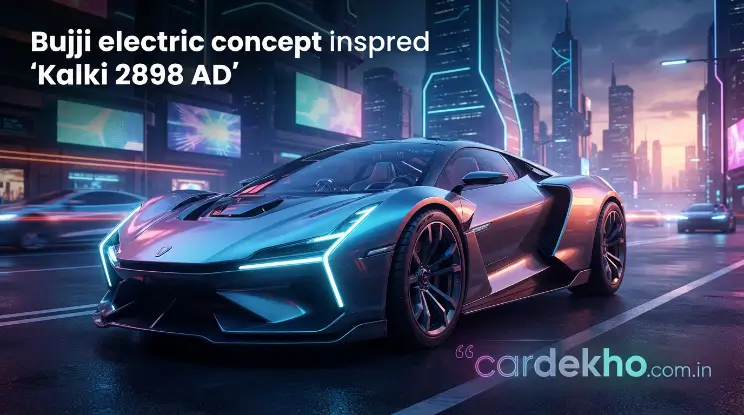
Welcome to CarDekho. The Bujji car is one of the most unusual vehicles to appear in Indian science-fiction cinema. Featured in Kalki 2898 AD as Bhairava’s futuristic vehicle, Bujji is presented as an AI-powered car and a trusted companion to Prabhas’ character. The vehicle combines a huge body, three-wheel layout, and unusual hubless wheels to create a distinctive futuristic design.
What makes the Bujji car even more interesting is that a real, working version was built for the movie’s promotional campaign. The physical vehicle weighs about six tonnes and uses a 47 kWh battery with twin electric motors. It was developed through a collaboration involving Mahindra’s engineering team and Jayem Automotives, turning a fictional future car concept into a driveable machine.
What Is the Bujji Car?
The Bujji car is a custom-built electric vehicle created for Kalki 2898 AD, where it serves as Bhairava’s futuristic vehicle and AI-powered companion. Unlike a normal car, Bujji can communicate with Bhairava and has its own personality within the story. A real working version was also built for the film’s promotional activities. The physical vehicle is more than six metres long and uses an unusual three-wheel layout, with two large hubless front wheels and one powered rear wheel.
Bujji’s Role in Kalki 2898 AD
In Kalki 2898 AD, Bujji belongs to Bhairava, played by Prabhas, and plays an important role beyond simply providing transportation. As an AI-powered vehicle, Bujji communicates with Bhairava, assists him during his journey, and adds humor to their interactions. This relationship makes Bujji an important part of Bhairava’s character and the film’s futuristic setting.
Bujji’s voice was provided by actress Keerthy Suresh. Her voice performance helped give the vehicle a distinct personality, making Bujji feel more like a character than an ordinary machine. This combination of artificial intelligence, humor, and futuristic technology is one of the reasons the Bujji car became a memorable part of the movie.
Is the Bujji Car a Real Vehicle?
Yes, the Bujji car is a real, functional vehicle rather than a CGI-only creation. The production team worked with automotive engineers to turn the fictional design into a drivable machine. Its development reportedly took around two years because the vehicle required custom components, including its unusual wheels, steering system, suspension, and electric powertrain.
The physical Bujji was not completed early enough to serve as the main vehicle during filming, so the movie used CGI and physical props where necessary. After its completion, the real vehicle was used extensively for promotional events and public appearances, allowing fans to see the futuristic machine outside the movie.
Bujji Car Specifications
The main Bujji car specifications show how different it is from a conventional passenger vehicle.
| Specification | Details |
| Vehicle type | Custom electric vehicle |
| Weight | Around 6 tonnes |
| Length | 6,075 mm |
| Width | 3,380 mm |
| Height | 2,186 mm |
| Battery | 47 kWh |
| Power | About 125–128 hp |
| Published torque | 9,800 Nm |
| Wheel layout | Three wheels |
| Front wheels | Two hubless wheels |
| Rear wheel | One powered wheel |
| Front rim size | 34.5 inches |
Published specifications vary slightly between reports, particularly for the power figure. Autocar India lists 128 hp, while NDTV reports 125 bhp. Both sources report the 47 kWh battery, approximately six-tonne weight, and 9,800 Nm torque figure.
Read also: Kids Car In Pakistan: Types, Price, Features & Buying Guide
Bujji Car Design and Features
The design is one of the most distinctive aspects of the Bujji car. Instead of resembling a conventional sedan, SUV, or sports car, it features a massive futuristic body built around a three-wheel configuration. The physical vehicle measures approximately 6,075 mm in length, 3,380 mm in width, and 2,186 mm in height, making it significantly larger than a typical passenger car. Its unusual proportions, large wheels, and custom-built structure were designed specifically to match the futuristic world of Kalki 2898 AD.
Three-Wheel Design
The Bujji car has two wheels at the front and a single powered wheel at the rear. This arrangement gives the vehicle its distinctive appearance and requires specially designed steering, suspension, and drivetrain components to handle its considerable size and weight.
Despite its unusual layout, the vehicle was built to be drivable. During Autocar India’s test drive, the steering system was reported to work effectively, allowing the driver to control the large vehicle without the handling difficulty its three-wheel design might suggest.
Hubless Front Wheels
One of the most eye-catching features of the Bujji car is its large hubless front wheels. Unlike conventional wheels that have a central hub connected to the axle, Bujji’s wheels use a different engineering arrangement that creates an open center and contributes to its futuristic appearance. The front wheels are fitted with 34.5-inch rims.
These custom wheels were designed to support the vehicle’s extreme size and weight. According to Autocar India, each front hubless wheel weighs around one tonne and incorporates specially developed suspension and braking components, making them a major part of Bujji’s overall engineering.
Steering, Suspension and Custom Tyres
The Bujji car uses an electro-hydraulic steering system developed specifically for its unusual architecture. Its steering wheel can also fold away and lock into position, adding to the vehicle’s unconventional interior and control system.
Because Bujji weighs around six tonnes, its suspension and tyres also had to be specially engineered. Custom tyres were developed for the vehicle, while the front wheels use multiple brake calipers to help manage its substantial mass. These features show that Bujji was designed as a functional electric vehicle, not merely as a decorative movie prop.
Bujji Car Battery, Motor and Performance
The Bujji car battery has a capacity of 47 kWh and is positioned toward the rear of the vehicle. It powers the vehicle’s electric drivetrain, which was specially developed for Bujji’s unusual size, weight, and three-wheel configuration. Because the physical vehicle weighs around six tonnes and uses a custom drivetrain, its battery capacity and performance should not be compared directly with those of ordinary electric cars.
47 kWh Battery
The 47 kWh battery provides the energy needed to power Bujji’s electric motors. According to Autocar India’s detailed report, the battery pack is located toward the rear of the vehicle, within the section designed to resemble the prison cage seen in the movie. Its placement also forms part of the vehicle’s overall engineering layout.
Unlike a conventional electric car, Bujji was built as a one-off futuristic vehicle with a very different size and weight. For this reason, the 47 kWh capacity alone does not indicate the same range or efficiency that a similarly sized battery might provide in a normal production EV.
Electric Motors and Torque
The physical Bujji car uses two air-cooled Kirloskar induction motors. Together, they produce a reported 94 kW of power, equal to approximately 128 hp. Autocar India also reports a torque figure of 9,800 Nm, an exceptionally high number that reflects Bujji’s custom drivetrain and gearing rather than a typical passenger-car setup.
For this reason, the 9,800 Nm figure should not be compared directly with the torque figures advertised for conventional EVs. Bujji’s unusual three-wheel architecture, gearing, and powered rear wheel make its drivetrain fundamentally different from most road-going electric vehicles.
How Fast Is the Bujji Car?
The physical Bujji car has a reported top speed of around 45 km/h, according to NDTV. During Autocar India’s test drive, however, the driver was instructed to keep the vehicle below 40 km/h, reflecting the controlled conditions under which the massive promotional vehicle was being operated.
These figures apply to the real-world Bujji built for Kalki 2898 AD. They should not be confused with the fictional vehicle’s capabilities in the movie, where Bujji is portrayed as a highly advanced futuristic vehicle with capabilities beyond those of the physical prototype.
Who Built the Bujji Car?
The physical Bujji car was developed through a collaboration between the Kalki 2898 AD production team, Mahindra’s engineering resources, and Jayem Automotives. The goal was to turn the film’s futuristic concept car into a real, driveable electric vehicle rather than leaving it as a CGI design. Because Bujji required unusual dimensions, wheels, suspension, and drivetrain components, the project involved extensive custom engineering.
Mahindra’s Engineering Contribution
Mahindra played a major role in developing the physical Bujji car, with work carried out at Mahindra Research Valley in Chennai. Its product development team helped translate the film’s visual concept into a functional vehicle, including the electric powertrain and other systems needed to make the large three-wheel design operational.
This engineering work was particularly important because Bujji was not based on a standard production-car platform. Mahindra’s involvement helped turn the movie’s futuristic design into a working prototype while maintaining the distinctive appearance required for the film.
Jayem Automotives’ Role
Jayem Automotives, based in Coimbatore, was another important partner in building the Bujji car. Autocar India identifies Jayem Automotives alongside Mahindra’s product development team as a key contributor to the vehicle’s construction and engineering.
The collaboration was necessary because Bujji required many bespoke automotive components instead of standard parts from an existing production vehicle. Its custom wheels, steering, suspension, and electric drivetrain all had to work together to support the vehicle’s unusual size and three-wheel configuration.
Bujji Car Price and Availability
The Bujji car price is a common question because of its unusual design, large size, and custom engineering. However, Bujji was created as a one-off electric vehicle for Kalki 2898 AD, not as a production model sold through regular dealerships. As a result, there is no standard retail price comparable to that of a normal passenger car.
How Much Does the Bujji Car Cost?
There is no officially confirmed retail price for the Bujji car because it was never launched as a conventional consumer vehicle. Online estimates may suggest how much it could cost to build a similar custom vehicle, but these figures should not be treated as an official price for Bujji.
The cost of creating Bujji involved custom design, engineering, fabrication, and specialized components. These development costs are very different from the pricing of a mass-produced electric car, making direct price comparisons with regular EVs unreliable.
Can You Buy a Bujji Car?
No regular production version of the Bujji car is available for consumers based on published information. The physical vehicle was built specifically for the Kalki 2898 AD project and later used for promotional appearances and events.
Bujji is therefore best understood as a custom movie vehicle and engineering project rather than a commercially available car. Unless a manufacturer develops a production version in the future, buyers cannot purchase a new Bujji through normal automotive dealerships.
Why Is the Bujji Car Different From a Normal EV?
The Bujji car differs from an ordinary EV in almost every major area.
| Feature | Bujji Car | Normal Electric Car |
| Purpose | Movie/promotional vehicle | Everyday transportation |
| Wheel layout | Three wheels | Usually four |
| Front wheels | Hubless | Conventional |
| Weight | Around 6 tonnes | Usually much lower |
| Battery | 47 kWh | Varies by model |
| Construction | Custom-built | Mass-produced |
| Availability | One-off project | Commercial models available |
| Design | Futuristic movie concept | Practical road design |
The most important difference is its purpose. Bujji was designed to bring a fictional future vehicle into the real world, so its unusual dimensions and mechanical systems were part of the concept rather than limitations that had to be eliminated.
How Bujji Was Created for Kalki 2898 AD
The physical Bujji car reportedly took around two years to develop, with the Kalki 2898 AD production team working alongside automotive engineers to turn the film’s futuristic concept into a real, driveable vehicle. The project required extensive custom engineering because Bujji was not based on a conventional car platform. Its development included a large electric powertrain, unusual hubless wheels, custom suspension, hydraulic steering, and a specially designed cabin, all built to match the vehicle’s fictional appearance.
The physical Bujji was completed too late to serve as the main vehicle during filming, so the production relied on props and computer-generated imagery where necessary. After completion, the real vehicle became an important promotional attraction, allowing audiences to see the Bujji car outside the film and demonstrating how a futuristic movie concept could be turned into a functioning prototype.
Bujji Car Key Facts
Here are the most important Bujji car facts at a glance:
- Bujji is an AI-powered vehicle in Kalki 2898 AD.
- It is associated with Prabhas’ character Bhairava.
- A real, functional version was built.
- The physical vehicle weighs about six tonnes.
- It uses a 47 kWh battery.
- It has two electric motors.
- Published power figures are around 125–128 hp.
- The reported torque figure is 9,800 Nm.
- It has two front hubless wheels and one rear wheel.
- Its front rims measure 34.5 inches.
- Mahindra and Jayem Automotives were involved in its development.
Frequently Asked Questions About Bujji Car
Is the Bujji car real?
Yes. A working Bujji car was built for the Kalki 2898 AD promotional campaign. It is a real electric vehicle rather than only a CGI creation.
What is the price of the Bujji car?
There is no officially established retail price because Bujji was not introduced as a normal production vehicle. Reported construction-cost estimates should therefore not be confused with an official Bujji car price.
What battery does the Bujji car use?
The physical Bujji car uses a 47 kWh battery pack. The battery is housed toward the rear of the vehicle.
Who built the Bujji car?
The physical Bujji was developed through a collaboration involving the film’s production team, Mahindra’s product development team, and Jayem Automotives. Mahindra Research Valley in Chennai was involved in its development.
Can I buy the Bujji car?
The Bujji car is not presented as a commercially available production model. It was built as a custom vehicle for the Kalki 2898 AD project and its promotional activities.
Conclusion
The Bujji car stands out because it successfully moved from a science-fiction concept to a real, functioning electric vehicle. Its six-tonne body, three-wheel configuration, hubless front wheels, and custom electric drivetrain make it very different from an ordinary road car.
For Kalki 2898 AD, Bujji is also more than transportation. It is an AI-powered companion to Bhairava and an important part of the film’s futuristic world. The physical vehicle shows how film design and automotive engineering can come together to create something that exists beyond the screen.
