

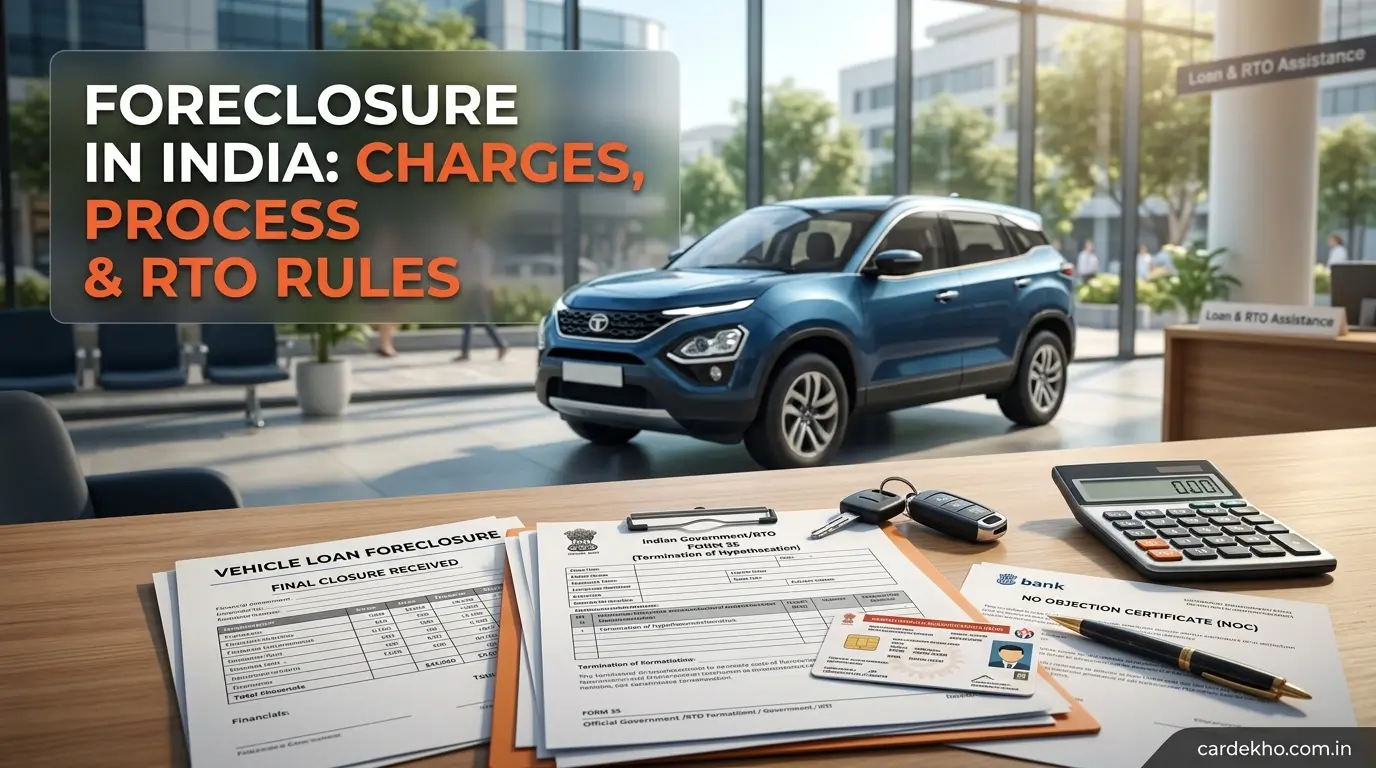
Welcome to CarDekho. Foreclosing a Foreclosure in India in India allows you to settle your outstanding principal balance before your tenure ends, ending your monthly EMI obligations. With rising interest rates and a desire to remain debt-free, many vehicle owners choose early closure to cut total interest costs and claim complete legal ownership of their car.
However, navigating the pre-closure process requires more than transferring money to your lender. To complete the closure properly, you must calculate lender foreclosure charges, obtain a bank No Dues Certificate (NOC), cancel the hypothecation on your Registration Certificate (RC) via the Form 35 RTO hypothecation cancellation process, and update your auto insurance policy.
What is Foreclosure in India?
Foreclosure in India (or auto loan pre-closure) is the full repayment of your outstanding principal balance in a single lump sum before the scheduled tenure ends. Once the payment settles, the loan agreement terminates, and the bank initiates the legal release of its hypothecation over the vehicle.
Foreclosure in India: Foreclosure vs. Prepayment: Key Differences
While both options involve paying down your debt early, they serve distinct financial purposes for vehicle owners. Foreclosure in India: Foreclosure fully terminates your loan agreement, clears the balance, and leads to hypothecation removal from your vehicle documents.
On the other hand, partial prepayment allows you to deposit a chunk of cash into the active loan without closing it. This strategy directly lowers your remaining principal, reducing either your ongoing monthly EMI or shortening your overall repayment tenure.
When Does Pre-closing Your Vehicle Loan Make Financial Sense?
Foreclosing makes the most financial sense during the first half of your loan tenure. Indian bank loans follow an amortized repayment structure where interest payments are heavily front-loaded during the initial years, so clearing the principal balance early maximizes your interest savings.
If you are in the final 12 to 18 months of a 5-year loan, most of your EMI goes toward the principal. In this case, paying Foreclosure in India pre-closure charges may cost more than the remaining interest charges, making early closure less beneficial.
Foreclosure in India: Foreclosure Charges in India Across Top Banks
Unlike home loans with floating interest rates where the Reserve Bank of India (RBI) mandates zero foreclosure fees Foreclosure in Indias carry fixed interest rates, allowing banks to apply prepayment penalties to compensate for lost future interest earnings.
RBI Guidelines and Lock-in Periods
Most Indian banks enforce a foreclosure lock-in period of 6 to 12 months before allowing foreclosure in India. Attempting to pre-close before this mandatory duration usually incurs higher penalties or is prohibited under the loan agreement terms.
Penalty fees typically range from 2% to 5% of the outstanding principal repayment, plus applicable Goods and Services Tax (18% GST). Lenders calculate these charges based on the remaining balance at the time of pre-closure.
Comparative Breakdown of Foreclosure Charges
Below is a comparison of pre-closure policies and penalty structures across major Indian banking institutions:
| Bank / Lender | Minimum Lock-in Period | Foreclosure Penalty Charges |
| State Bank of India (SBI) | No lock-in (or 1st EMI) | Minimal to Nil charges (varies by scheme) |
| HDFC Bank | 6 Months / 6 EMIs | 3% to 6% of outstanding principal + GST |
| ICICI Bank | 6 Months / 6 EMIs | 3% to 5% of outstanding principal + GST |
| Axis Bank | 6 Months / 6 EMIs | 5% of principal balance + GST |
| Bank of Baroda | 1 to 6 EMIs | 0% to 3% depending on tenure stage |
Read also: Car Valuation Guide: How Much Is Your Vehicle Really Worth?
Step-by-Step Foreclosure in India: Foreclosure Process (Online & Offline)
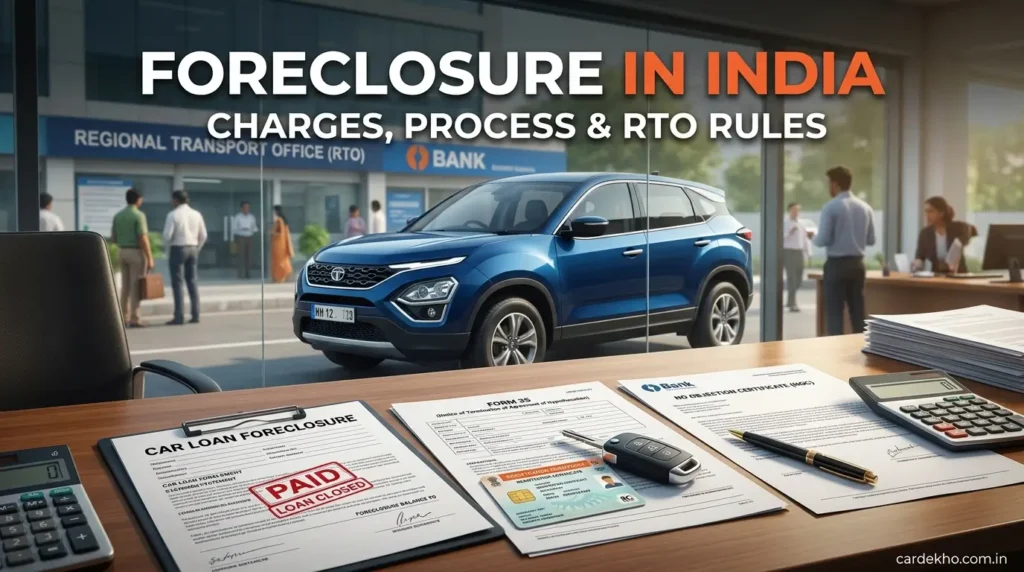
Executing a Foreclosure in India requires completing sequential administrative steps across both your lender and the regional transport authorities.
Step 1: Requesting the Foreclosure Statement
Visit your lender’s nearest branch or log into their net banking or mobile app to request a formal Foreclosure Statement (Payoff Quote). This document details the exact outstanding principal balance, accrued interest up to the payment date, foreclosure fees, and 18% GST.
Review all line items in the statement carefully to confirm that the calculations align with your loan agreement. Verify the payoff validity date, as interest accrues daily until the full settlement payment is received.
Step 2: Clearing Outstanding Principal, Dues & Taxes
Pay the precise settlement amount indicated in the foreclosure statement using Demand Draft, Cheque, or online transfer via NEFT/RTGS. Ensure that all pending late fees or administrative charges are included in the transfer to prevent partial settlement issues.
Once processed, obtain an official payment acknowledgment receipt and account statement from the bank confirming a zero balance. Retain these payment records as proof of complete financial settlement.
Step 3: Collecting NOC and Form 35 from the Lender
Within 10 to 15 working days after settlement, your bank issues the necessary legal clearance documents. These include a Bank No Dues Certificate (NOC) confirming all dues are paid, two signed copies of Form 35 for Form 35 RTO hypothecation cancellation, and any retained vehicle documents or duplicate keys.
Inspect all issued paperwork for correct vehicle engine numbers, chassis details, and owner names. Note that the Bank No Dues Certificate (NOC) remains valid for only 90 days from its issuance date.
Step 4: Removing Hypothecation at the RTO (Parivahan Portal)
Submit your documentation to your local Regional Transport Office (RTO) or initiate the process online via the Parivahan RC status update portal. You must provide the original RC book/smartcard, original Bank No Dues Certificate (NOC), signed Form 35 copies, active insurance certificate, PUC test result, and identity proof.
Pay the applicable RTO processing fees and submit the application for verification. The transport authority will process the request and issue an updated Registration Certificate free of bank hypothecation.
Step 5: Updating Motor Insurance Policy Records
Submit a copy of your updated RC smartcard along with the Bank No Dues Certificate (NOC) to your motor insurance provider. This ensures your official vehicle policy reflects the removal of the bank’s financial lien.
The insurance company will update their records and issue a revised endorsement certificate. This step guarantees smooth claim settlements and unhindered policy transfers in the future.
Critical Documents Required for Closing an Auto Loan
Ensure you collect and prepare all necessary documentation to complete the foreclosure and hypothecation removal process smoothly:
- Government-Issued Photo ID & Address Proof: Aadhaar Card, PAN Card, Driving License, or Passport.
- Loan Details: Loan Account Number and original sanction letter.
- Payment History Proof: Bank statement showing your latest EMI debits.
- Vehicle Documentation: Registration Certificate (RC), current active Insurance Policy, and Pollution Under Control (PUC) Certificate.
- Foreclosure Application: Form signed by the primary account holder requesting account closure.
Impact of Auto Loan Foreclosure on Your CIBIL Score
Executing a Foreclosure in India generally improves your credit profile long-term, though you may notice minor short-term adjustments to your overall score.
Short-term Dip vs. Long-term Credit Score Enhancement
When a loan account closes, your total credit mix changes. This temporary CIBIL score impact on loan prepayment happens because closing your only active secured credit line may slightly reduce your average credit history age.
However, as credit bureaus update your profile to show zero debt balance, your financial discipline becomes evident. Your overall credit rating recovers and strengthens over the following months.
How Debt-to-Income (DTI) Ratio Improves for Future Loans
Clearing your Foreclosure in India eliminates a recurring monthly liability, which directly lowers your overall debt-to-income ratio. This structural improvement increases your available monthly disposable income on paper.
A lower DTI ratio marks you as a low-risk borrower for financial institutions. This boosts your approval odds and negotiating leverage when applying for major credit facilities like home loans.
Pros and Cons of Foreclosing Early in India
| Aspect | Benefits (Pros) | Drawbacks (Cons) |
| Financial Impact | Substantial Interest Savings: Cuts off remaining annual interest obligations, saving thousands of rupees over the original loan term. | Penalty & Tax Overhead: Payment of Foreclosure in India pre-closure charges (2%–5%) plus 18% GST reduces your overall net savings. |
| Vehicle Status & Cash Flow | Unencumbered Ownership: Eliminates the bank’s financial lien, allowing you to sell, transfer, or modify the vehicle freely. | Opportunity Cost: Allocating a large cash lump sum to foreclose a low-interest loan may earn lower net returns than deploying those funds into higher-yielding investments like Mutual Fund SIPs or Equity funds. |
| Monthly Budget | Improved Cash Flow: Frees up monthly cash formerly committed to EMIs for investments, emergency reserves, or savings. |
Common Mistakes to Avoid During Foreclosure in India: Pre-closure
Keep the following operational pitfalls in mind to avoid unnecessary delays, extra fees, or legal complications during pre-closure:
- Ignoring RTO Hypothecation Removal: Obtaining a Bank No Dues Certificate (NOC) is only the first step. If you fail to complete the Form 35 RTO hypothecation cancellation process, the bank legally remains listed as the hypothecated owner, preventing future vehicle sales.
- Missing the NOC Validity Window: Most bank NOCs expire 90 days after issuance. If you let it lapse before submitting it to the RTO, you must re-apply at the bank branch for a fresh certificate.
- Foreclosing Late in the Loan Term: Pre-closing during the final 12 months often yields minimal interest savings while still incurring transaction fees. Calculate your exact net savings before paying off the balance.
- Forgetting to Cancel Automated Mandates: Ensure your e-NACH, ECS, or auto-debit standing instructions are formally canceled with your bank to prevent extra EMI deductions after closure.
Frequently Asked Questions
Is it mandatory to visit the bank branch in person to complete a Foreclosure in India?
While you can initiate the payoff request and pay the outstanding balance online, you must usually visit a branch to submit a signed foreclosure application and collect physical documents like the No Objection Certificate (NOC) and Form 35.
Does pre-closing a Foreclosure in India automatically update the vehicle owner’s details on the Parivahan portal?
No, paying off the loan does not automatically update government databases; you must manually submit the bank’s NOC and signed Form 35 to your regional RTO or via the Parivahan portal to remove the hypothecation lien.
What happens if I lose or misplace the original Form 35 issued by my bank?
If Form 35 is lost, you must re-apply at your lender’s branch for duplicate copies, which may require submitting an indemnity bond or written application confirming the loss.
Can I foreclose a Foreclosure in India if I have unpaid late payment charges or pending penalties?
No, banks require you to clear all accrued late fees, bounced payment penalties, and administrative charges alongside the outstanding principal before they will issue a foreclosure statement and NOC.
Does foreclosing a loan in India affect my existing vehicle insurance policy coverage?
Your core insurance coverage remains fully active, but you must inform your insurance provider and submit your updated RC so they can issue an endorsement removing the bank as a loss payee.
Conclusion
Foreclosing your loan in India early is a smart way to become debt-free and stop paying extra interest. It clears your monthly EMI burden and gives you full ownership of your vehicle. However, always calculate your net savings after bank fees before making a lump-sum payment.
Getting your bank NOC is only half the job done. Make sure to complete the RTO process to remove the hypothecation from your RC book as well. Taking care of all the paperwork on time ensures a smooth, hassle-free loan closure.
