


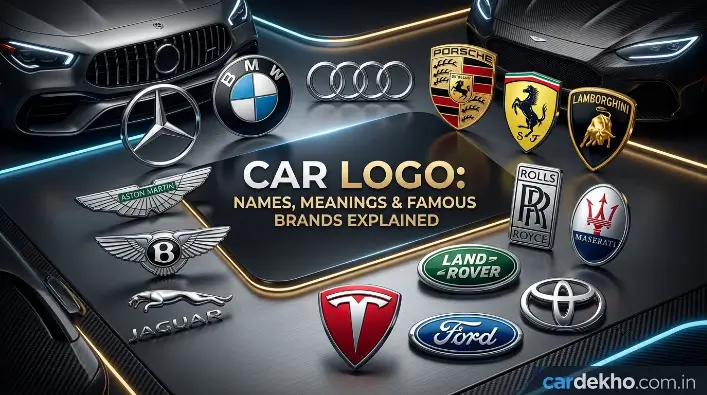
Welcome to CarDekho. A car logo is not just a decorative symbol on a vehicle; it represents the identity and image of the automobile manufacturer. When people see a familiar logo such as Toyota, BMW, or Ferrari, they can often recognize the brand immediately. These logos may also reflect a company’s history, values, luxury, performance, reliability, or technological focus.
Understanding a car logo can also help you identify an unfamiliar vehicle more easily. Different manufacturers use unique letters, animals, stars, shields, rings, wings, and other shapes in their designs. In this guide, you will learn about famous car logos, their meanings, the symbols they use, different car brands, and simple ways to identify an unknown automotive logo.
What Is a Car Logo and Why Does It Matter?
A car logo is the visual identity of an automobile manufacturer and is used to make a vehicle instantly recognizable. You can commonly find it on the front grille, steering wheel, wheels, rear of the vehicle, and sometimes inside the cabin. While the terms logo, emblem, and badge are often used interchangeably, a logo is technically the graphic design representing the brand. In contrast, an emblem or badge is the physical version attached to the car. Beyond identification, a car logo can communicate a manufacturer’s history, values, market position, and overall image, helping the brand stand apart from competitors and remain memorable to customers.
Logo vs. Car Emblem vs. Badge
A logo is the graphic symbol or design that represents a company’s brand, while an emblem or badge is the physical version displayed on the vehicle. In everyday car discussions, these terms are commonly used in the same way, so phrases such as BMW logo.
Toyota badge, or Mercedes-Benz emblem generally refer to the recognizable symbol placed on the vehicle. Understanding this small difference is useful when discussing automotive branding, although all three terms are closely connected to how people identify a car manufacturer.
Why Car Brands Use Distinctive Logos
Car manufacturers use distinctive logos to create a strong and memorable identity that customers can recognize quickly. A well-designed car logo can communicate qualities such as luxury, performance, reliability, innovation, or heritage while also supporting advertising and marketing.
Some manufacturers preserve historical elements in their logos to maintain a connection with their origins, while others use modern designs to represent technology and a changing market. Ultimately, a recognizable badge helps a company distinguish its vehicles from competitors and can influence how customers perceive the brand.
- Brand recognition: Helps people identify the manufacturer quickly.
- Brand identity: Communicates the company’s style and market position.
- Heritage: Can preserve important elements of the brand’s history.
- Marketing: Creates a consistent visual identity across cars and advertising.
- Customer perception: Can reinforce ideas such as luxury, performance, reliability, or innovation.
Read Also: Mahindra New Car: Latest Models, Prices & Features 2026
Most Famous Car Logos and Their Meanings
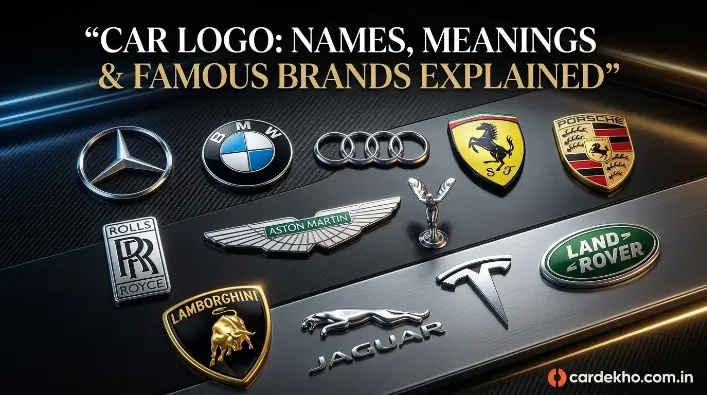
The world’s most famous car logo designs are recognized because they combine memorable symbols, simple shapes, company history, and strong brand identity. Some logos represent the manufacturer’s name or initials, while others are connected to founders, geographical origins, engineering ideas, motorsport, or traditional symbols. From Toyota’s overlapping ovals and Audi’s four rings to Ferrari’s prancing horse and Lamborghini’s bull, each emblem gives a vehicle its own visual identity. Understanding these designs can make it easier to recognize different manufacturers and learn what makes their branding unique.
Toyota, Honda, Suzuki, Kia and Hyundai
Toyota uses three overlapping oval shapes to create one of the most recognizable automotive badges, while Honda uses a bold stylized “H” that is easy to identify on its passenger vehicles. Suzuki’s angular “S” is based on the first letter of its name, while Kia uses a modern connected-letter wordmark as part of its updated brand identity.
Hyundai features a stylized “H” inside an oval, giving the brand a distinctive appearance. These manufacturers are particularly familiar in Asian markets, including Pakistan, and their car logo designs can be seen on sedans, hatchbacks, SUVs, and other vehicles, making them useful examples for anyone learning how to identify automobile brands.
BMW, Mercedes-Benz, Audi and Volkswagen
German manufacturers have some of the most recognizable car logo designs in the world. BMW uses its famous circular blue-and-white badge, Mercedes-Benz is represented by its three-pointed star, Audi uses four connected rings, and Volkswagen combines the letters “V” and “W” inside a circle.
These simple but distinctive designs allow drivers to recognize a manufacturer even when they do not know the exact vehicle model. Their consistent use across cars, advertising, dealerships, and digital platforms has made these logos strongly connected with German automotive brands and their long-established identities.
Ferrari, Lamborghini, Porsche and Maserati
Luxury and performance manufacturers often use more expressive symbols to represent their heritage and premium image. Ferrari is famous for its prancing horse, Lamborghini uses a bull inside a shield, Porsche features a detailed crest, and Maserati uses a trident.
These car logo designs are closely associated with performance, motorsport, luxury, and exclusivity, making them highly recognizable among car enthusiasts. Unlike simple letter-based badges, these symbols can communicate a strong brand identity even without displaying the manufacturer’s name.
Ford, Chevrolet, Jeep, and Tesla
American and modern automotive brands use different approaches to create recognizable identities. Ford is known for its oval badge, Chevrolet uses its distinctive bowtie symbol, Jeep uses a simple wordmark associated with SUVs and off-road vehicles, and Tesla uses a stylized “T” connected with electric vehicles and modern technology.
These examples show that a successful car logo does not have to follow one specific design style; whether a brand uses letters, symbols, shapes, or a combination of these elements, the main purpose is to make the manufacturer easy to recognize and remember.
Car Logo Meanings: Symbols, Shapes and Colors
A car logo is designed to give an automobile brand a distinctive visual identity and help customers recognize it quickly. Different manufacturers use animals, stars, shields, rings, wings, letters, and geometric shapes to communicate ideas such as strength, performance, luxury, heritage, innovation, or movement. Some symbols have a specific connection to a company’s history, while others are mainly chosen because they are memorable and visually appealing. By understanding these common design elements, you can better recognize an unfamiliar car logo and understand how automotive brands use visual identity to stand apart from competitors.
Animals, Stars and Shields
Animals are commonly used in automotive branding because they can represent qualities such as power, speed, courage, strength, or performance. Ferrari’s prancing horse and Lamborghini’s bull are famous examples, while stars can suggest excellence, ambition, achievement, or heritage depending on the manufacturer.
Shield-shaped designs are also popular among luxury and performance brands because they can create an impression of tradition, protection, prestige, and authority. However, these symbols do not have one fixed meaning across the automotive industry; their true meaning depends on the individual manufacturer’s history and branding choices.
Rings, Wings, Letters and Geometric Shapes
Rings, wings, letters, and geometric shapes are also important elements in a car logo. Audi’s four connected rings show how a simple geometric design can become instantly recognizable, while wings can represent movement, freedom, speed, or progress. Letters and initials are often used to connect a logo directly with a company’s name, making the brand easier to remember.
Geometric designs are especially useful for modern manufacturers because they remain clear at different sizes and work effectively on car grilles, steering wheels, websites, mobile screens, advertisements, and social media. A simple and flexible design can therefore remain recognizable across both physical and digital platforms.
Car Logos by Country and Car Brand Category
Organizing car logos by country and brand category makes it easier to understand the global automobile industry and recognize manufacturers from different regions. Every country has developed its own automotive traditions, and many manufacturers have created distinctive logos that reflect their history, design philosophy, market position, or vehicle technology. Grouping brands into Japanese, Korean, German, European, American, and other global categories gives readers a simple way to learn where different car brands come from and how their visual identities differ.
Japanese and Korean Car Logos
Japanese manufacturers such as Toyota, Honda, Suzuki, Nissan, and Mazda use distinctive logos across a wide range of vehicles, including hatchbacks, sedans, SUVs, and performance cars. Their car logo designs generally use recognizable letters, shapes, or symbols that make each manufacturer easy to distinguish.
Korean brands such as Kia and Hyundai have also developed strong modern identities, with their logos appearing on passenger cars, SUVs, and electric vehicles. For Pakistani car buyers, recognizing Japanese and Korean car logo designs is particularly useful because these brands are commonly seen in the local automotive market.
German and European Car Logos
Germany is known for major automobile manufacturers such as BMW, Mercedes-Benz, Audi, Volkswagen, and Porsche, whose logos are strongly associated with engineering, premium vehicles, performance, and automotive heritage. Other European manufacturers also have distinctive identities.
Including Volvo’s circular-and-arrow design and Italian brands such as Ferrari, Lamborghini, and Maserati, which use symbols closely connected with luxury and performance. These European car logo designs demonstrate how manufacturers can use historical symbols, unique shapes, and traditional elements to create badges that remain recognizable around the world.
American and Other Global Car Logos
American brands such as Ford, Chevrolet, Jeep, and Tesla have created recognizable car logo designs used on passenger cars, SUVs, pickup trucks, and electric vehicles around the world. Ford’s oval badge, Chevrolet’s bowtie, Jeep’s wordmark, and Tesla’s stylized “T” show how different visual approaches can create strong brand recognition.
Other international manufacturers have also developed distinctive emblems, while established brands continue updating their designs for modern vehicles and digital platforms. As a result, a car logo has become an important part of global automotive branding, helping manufacturers maintain a recognizable identity across different countries and vehicle categories.
How to Identify an Unknown Car Logo
Identifying an unfamiliar car logo becomes easier when you examine its main design elements instead of trying to remember every automobile brand. Look carefully at the logo’s shape, letters, symbols, borders, and overall style, then compare these details with familiar automotive brands. The vehicle itself can also provide useful clues, so consider its body type, grille, headlights, wheels, and overall appearance. By combining the logo with the car’s exterior design, you can narrow down the manufacturer and identify an unknown vehicle more accurately.
Look at the Shape and Main Symbol
Start by checking the basic shape of the car logo and its main symbol. Determine whether the badge is circular, oval, rectangular, shield-shaped, or made from connected rings, then look for recognizable elements such as animals, stars, wings, letters, or geometric patterns.
If the badge contains a letter or initials, they may be connected to the manufacturer’s name, while a distinctive animal or object can provide an even stronger clue. Looking at several design elements together is more reliable than focusing only on the logo’s color.
Check the Badge Style and Vehicle
The car logo should be considered together with the vehicle carrying it because the car’s design can provide additional identification clues. Look at the body style, grille, headlights, wheels, proportions, and overall appearance to determine whether it is a sedan, SUV, hatchback, sports car, or another type of vehicle. You can follow these simple steps:
- Observe the main symbol: Identify the most noticeable part of the badge.
- Look for letters: Check for initials or recognizable lettering.
- Note the shape: Examine the badge’s outline and border.
- Consider the vehicle: Use its body style and exterior design as clues.
- Compare brands: Match the details with familiar automotive logos.
Using multiple clues together makes identification more accurate than relying on the car logo alone. This approach is especially helpful when two manufacturers use similar shapes, letters, or symbols in their badges.
Car Logo History, Changes and Common Questions
A car logo is an important part of a manufacturer’s identity, but its design can change over time as the company, technology, vehicles, and customer preferences evolve. Older badges were often detailed and decorative, while modern logos usually focus on cleaner lines, simpler shapes, and designs that are easy to recognize. Manufacturers may redesign their logos to create a more modern image, simplify the appearance, or make the badge work effectively on vehicles, websites, smartphones, advertisements, and social media. This is why an older vehicle may have a noticeably different car logo from the current version used by the same brand.
How Car Logos Have Changed Over Time
Early automotive badges often contained detailed artwork and decorative elements because manufacturers wanted their vehicles to look distinctive and prestigious. As the automotive industry developed, companies needed logos that were easier to recognize, reproduce, and use in different types of marketing.
Modern car logo designs therefore tend to use cleaner lines, simpler shapes, and flatter graphics. This approach allows the logo to remain clear on a vehicle grille or steering wheel while also looking sharp on digital screens, websites, advertisements, and social media.
Common Mistakes When Identifying Car Logos
Identifying a car logo can sometimes be confusing because different manufacturers may use similar shapes, letters, or symbols. Avoiding a few common mistakes can make the process easier:
- Confusing similar symbols: Circles, rings, letters, and shields can appear in different brands.
- Mixing up model and manufacturer: The model name is different from the car brand.
- Relying only on color: Logo colors can vary between versions and vehicles.
- Ignoring updated designs: Older and newer logos from the same brand may look different.
- Looking only at the badge: The vehicle’s grille, headlights, body style, and wheels can provide useful clues.
The best way to identify an unfamiliar car logo is to combine several clues rather than depending on one feature. Examine the symbol, shape, lettering, and badge style, then compare them with the vehicle’s overall design and body type.
Frequently Asked Questions
What is a car logo?
A car logo is the visual symbol or design used by an automobile manufacturer to represent its brand. It is commonly displayed on the front, rear, steering wheel, wheels, and other parts of a vehicle.
Which car logos are the most recognizable?
Toyota, BMW, Mercedes-Benz, Audi, Honda, Ford, Ferrari, Porsche, Volkswagen, and Tesla are among the many automotive brands with highly recognizable logos worldwide.
What is the difference between a car logo and a badge?
A logo is the brand’s visual identity, while a badge or emblem is the physical version of that branding attached to a vehicle. In everyday conversation, however, the terms are often used interchangeably.
Why do car logos have different symbols?
Car manufacturers use different symbols to create unique identities. Their designs can reflect company history, initials, geographical origins, performance, luxury, technology, or other brand values.
Can a car logo change over time?
Yes. Manufacturers can redesign their logos to modernize their identity, simplify the design, improve digital visibility, or mark a new stage in the company’s development.
Conclusion
A car logo is an important part of a vehicle’s identity because it helps people recognize the manufacturer quickly. Brands such as Toyota, Honda, BMW, Mercedes-Benz, Ferrari, and Tesla use different shapes, letters, symbols, and design elements to create a unique visual identity. These logos can also reflect a company’s history, values, technology, luxury, performance, or overall brand image, making them more than just decorative badges on a vehicle.
Learning how to identify a car logo is useful for both beginners and car enthusiasts. By paying attention to the badge’s shape, symbols, letters, colors, and connection with the vehicle’s overall design, you can often determine the manufacturer more easily. Whether you are researching car brands, comparing different vehicles, or interested in automotive history, understanding car logo meanings gives you a better appreciation of how automobile manufacturers build recognizable and memorable brands.
