

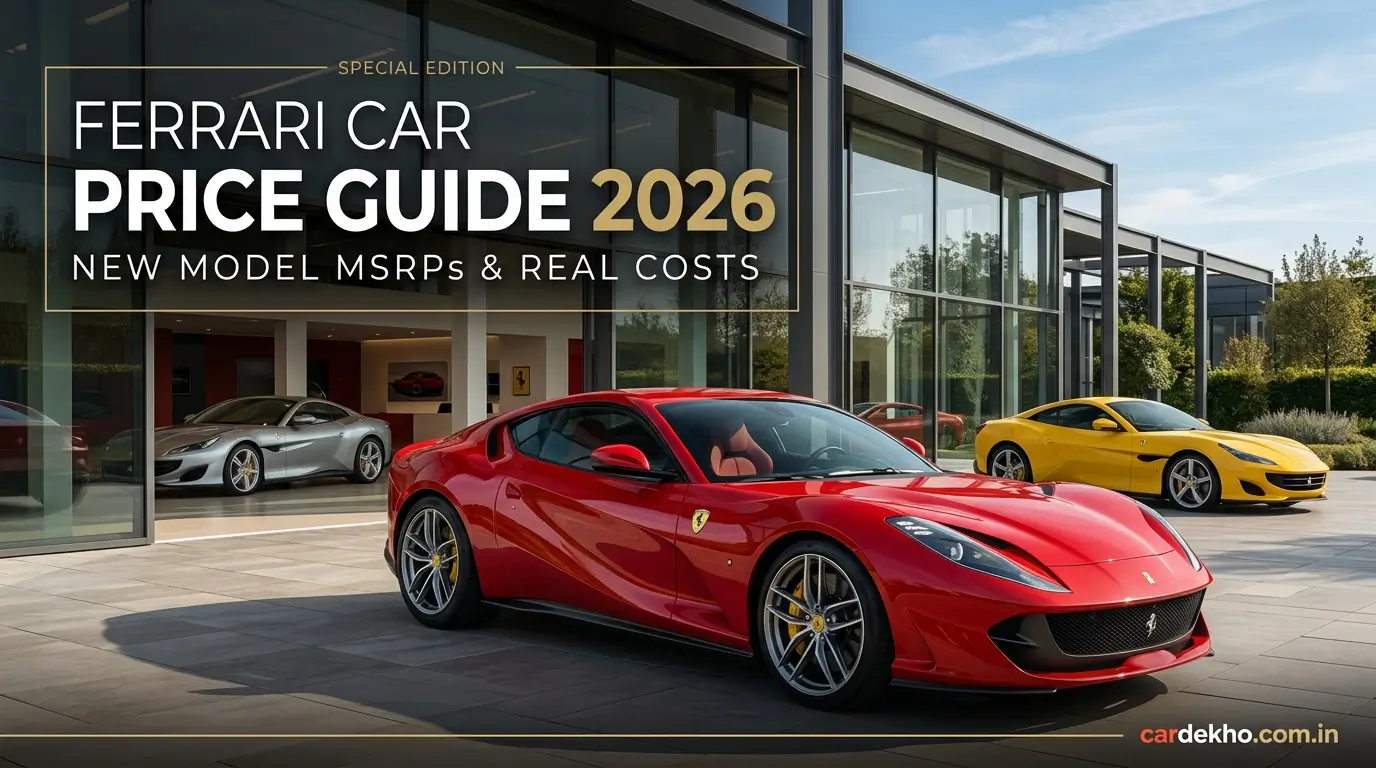
Welcome to CarDekho. The exact Ferrari car price requires looking past base figures and examining window stickers, custom specifications, and regional delivery fees. Ferrari represents the pinnacle of automotive engineering, combining legendary racing heritage with cutting-edge hybrid and internal combustion powertrains. As a result, securing a new vehicle from Maranello involves a significant financial commitment that varies widely depending on model selection.
Navigating the brand’s current pricing landscape means evaluating diverse vehicle segments, ranging from front-engine grand tourers to high-performance mid-engine hybrids and exclusive limited-run hypercars. Whether you are considering an entry point into the brand or evaluating flagship V12 offerings, having precise pricing data ensures a clear picture of total acquisition costs.
Ferrari Car Price Overview: Current Production Lineup
The Ferrari MSRP list starts under $250,000 for entry-level grand tourers and extends beyond $500,000 for flagship production models, with baseline supercars pricing figures reflecting standard factory figures before optional equipment, dealer delivery, and local taxes.
| Model Name | Body Style | Powertrain | Base MSRP (USD) |
| Ferrari Roma | Coupe | 3.9L Twin-Turbo V8 | ~$247,000 |
| Ferrari Roma Spider | Convertible | 3.9L Twin-Turbo V8 | ~$280,000 |
| Ferrari 296 GTB | Berlinetta | 3.0L Twin-Turbo V6 PHEV | ~$338,000 |
| Ferrari 296 GTS | Spider | 3.0L Twin-Turbo V6 PHEV | ~$375,000 |
| Ferrari Purosangue | 4-Door / SUV | 6.5L Naturally Aspirated V12 | ~$430,000 |
| Ferrari 12Cilindri | Coupe | 6.5L Naturally Aspirated V12 | ~$465,000 |
| Ferrari 12Cilindri Spider | Spider | 6.5L Naturally Aspirated V12 | ~$510,000 |
Detailed Ferrari Car Price Breakdown by Model
Under the section Detailed Ferrari Car Price Breakdown by Model, exact MSRP ranges are defined across the entry-level Roma, mid-engine hybrid 296 GTB/GTS, flagship V12 12Cilindri, and the high-utility Purosangue SUV. Each subsection highlights engine specifications, body designs, and starting price points to clearly explain how engineering and performance dictate final costs.
Ferrari Roma & Roma Spider Price
The Ferrari Roma represents the cheapest Ferrari car price available in the new production inventory, serving as the official entry point to the lineup. Powered by an award-winning 3.9-liter twin-turbo V8, the Roma coupe carries an estimated base price near $247,000.
For buyers seeking open-top driving, the Roma Spider commands an estimated base price around $280,000. Both variants balance daily usability with classic Italian styling, making them popular choices for first-time owners evaluating the entry-level Ferrari price tier.
Ferrari 296 GTB & 296 GTS Price
Positioned as the core mid-engine supercar, the 296 series introduces advanced plug-in hybrid technology paired with a high-revving twin-turbo V6 engine. The 296 GTB MSRP starts around $338,000, delivering 818 horsepower to the rear wheels.
The open-top variant, the 296 GTS, sits near $375,000. These models highlight modern Ferrari hybrid price structures, where electric motors complement traditional petrol power for elevated track performance.
Ferrari 12Cilindri & 12Cilindri Spider Price
Replacing the 812 Superfast, the 12Cilindri serves as the modern flagship front-engine V12 grand tourer. Delivering iconic engine acoustics and 819 horsepower, this model commands a substantial premium.
The coupe carries an estimated base price of $465,000, while the 12Cilindri Spider reaches $510,000 before options. As a premier V12 Ferrari price model, it targets collectors dedicated to naturally aspirated twelve-cylinder engines.
Ferrari Purosangue Price
As the brand’s first four-door vehicle, the Purosangue combines crossover versatility with a traditional V12 power plant. The official Purosangue sticker price starts at approximately $430,000, but high factory demand often pushes delivered prices significantly higher.
This model satisfies buyers searching for a functional 4-door Ferrari cost option without sacrificing exotic performance. Its four-seat layout, suicide rear doors, and active suspension system make it one of the most versatile vehicles Maranello has ever produced.
Limited Edition & Hypercar Ferrari Prices
Beyond standard production models, limited-run halo cars command significantly higher baseline prices. Track-focused special editions like the SF90 XX Stradale regularly start above $890,000, catering strictly to top-tier client lists.
Furthermore, ultra-exclusive Icona series cars like the Daytona SP3 demand over $2.2 million at launch, while flagship hypercars like the F80 push initial pricing upwards of $3.9 million. Due to extreme allocation limits, these models frequently appreciate rapidly on the secondary market.
Read also: Rolls Royce Car Price Breakdown: Complete 2026 Pricing & Model Guide
Key Factors Influencing Total Ferrari Car Price
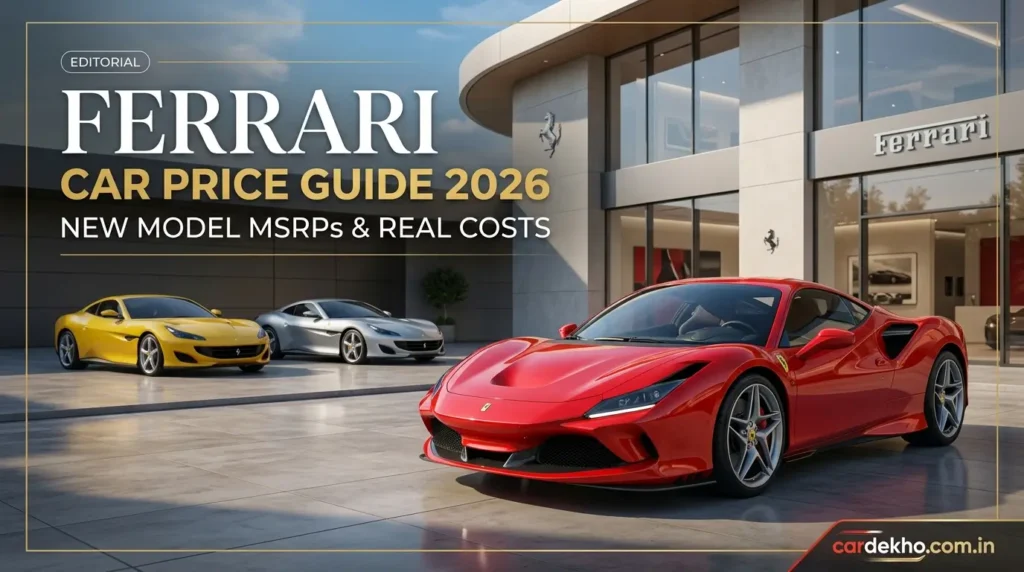
Bespoke factory customization adds high costs, as options like carbon-fiber trims, custom paint, and tailored cabin finishes typically add $50,000 to over $150,000 to the final window sticker. Furthermore, high global demand and strict production limits create dealer markups and market premiums for buyers seeking immediate delivery. Finally, long-term operational expenses must be factored in, including specialized exotic car insurance (4,000–10,000+ annually), post-warranty routine maintenance after the initial 7-year program ends, and delivery fees or local taxes.
Factory Options & Tailor-Made Customization Costs
Rarely does a car leave Maranello at base MSRP, as factory customizations significantly change the final Ferrari window sticker additions, adding anywhere from $50,000 to over $150,000 depending on specification choices.
These options typically include high-value structural and visual upgrades selected during the ordering process:
- Premium carbon fiber exterior and interior trims ($20,000 – $60,000)
- Historic or Paint-to-Sample custom color finishes ($12,000 – $35,000)
- Racing seats, titanium exhaust setups, and forged wheels ($10,000 – $30,000)
Dealer Markups, Allocations & Market Premiums
High market demand and tight factory quotas create strong price pressure that directly impacts real-world acquisition costs. Securing a new model allocation frequently requires an established purchasing history with an authorized dealer.
On the open market, buyers often pay substantial premiums above original sticker prices to skip multi-year waiting lists. This supply restriction guarantees that desirable allocations command high secondary market pricing.
Essential Ownership Costs Beyond Purchase Price
Acquiring the vehicle is only one part of the financial equation, as true ownership requires budgeting for recurring operational expenses over time.
Key ownership fees consist of routine upkeep, protection, and regional logistics:
- Annual Maintenance: Scheduled servicing averages $1,500 to $3,500 per year, though new vehicles include a 7-year factory maintenance plan.
- Insurance Costs: Specialized luxury auto insurance typically ranges between $4,000 and $10,000 annually based on driving history and garage security.
- Delivery & Taxes: Gas guzzler taxes and destination charges add $5,000 to $10,000 upfront.
Pre-Owned vs. New Ferrari Car Pricing
Purchasing a used Ferrari car price entry point offers alternative routes into brand ownership. Modern mid-engine V8 models like the 458 Italia (180,000–240,000) or 488 GTB (210,000–260,000) offer strong value stability compared to ordering brand new.
Furthermore, exploring Certified Pre-Owned (CPO) Ferrari cost options provides factory warranty backing and thorough technical inspections. These CPO programs offer buyers long-term confidence and exceptional appreciation potential over time.
Frequently Asked Questions
What is the typical wait time between placing a deposit and taking delivery of a brand-new Ferrari?
Most production Ferrari orders require a waiting period ranging from 18 to 24 months due to strict factory quotas and bespoke customization schedules.
How much initial deposit is required by authorized dealerships to secure a factory production allocation?
Dealerships generally require a minimum initial deposit of $20,000 to $50,000 to reserve a standard production slot, while limited-series models often require significantly higher commitments.
Are there additional regional tax penalties applied to new Ferrari purchases based on high performance?
Yes, depending on fuel efficiency ratings, buyer location, and engine displacement, high-performance models may incur substantial additional gas-guzzler taxes or luxury import duties at delivery.
Can a first-time buyer purchase an exclusive limited-series or halo Ferrari model directly from the factory?
No, limited-production halo models are offered almost exclusively to existing top-tier collectors who maintain a vetted purchase history with the factory.
What happens to the resale value of factory-installed optional carbon fiber components on the pre-owned market?
Factory-installed carbon fiber packages retain an exceptionally high percentage of their original cost, making carbon-equipped models significantly more desirable to prospective pre-owned buyers.
Conclusion
Determining the true Ferrari car price involves looking beyond base MSRP figures. Factory customizations, dealer allocation demands, and initial taxes significantly increase final window sticker costs. Understanding these pricing variables ensures buyers make informed decisions across the current lineup.
Long-term ownership requires budgeting for insurance, specialized care, and post-warranty servicing. While standard production cars experience normal market depreciation, rare models and limited editions often appreciate over time. Ultimately, owning a Ferrari remains a premium investment in high-performance engineering.
