


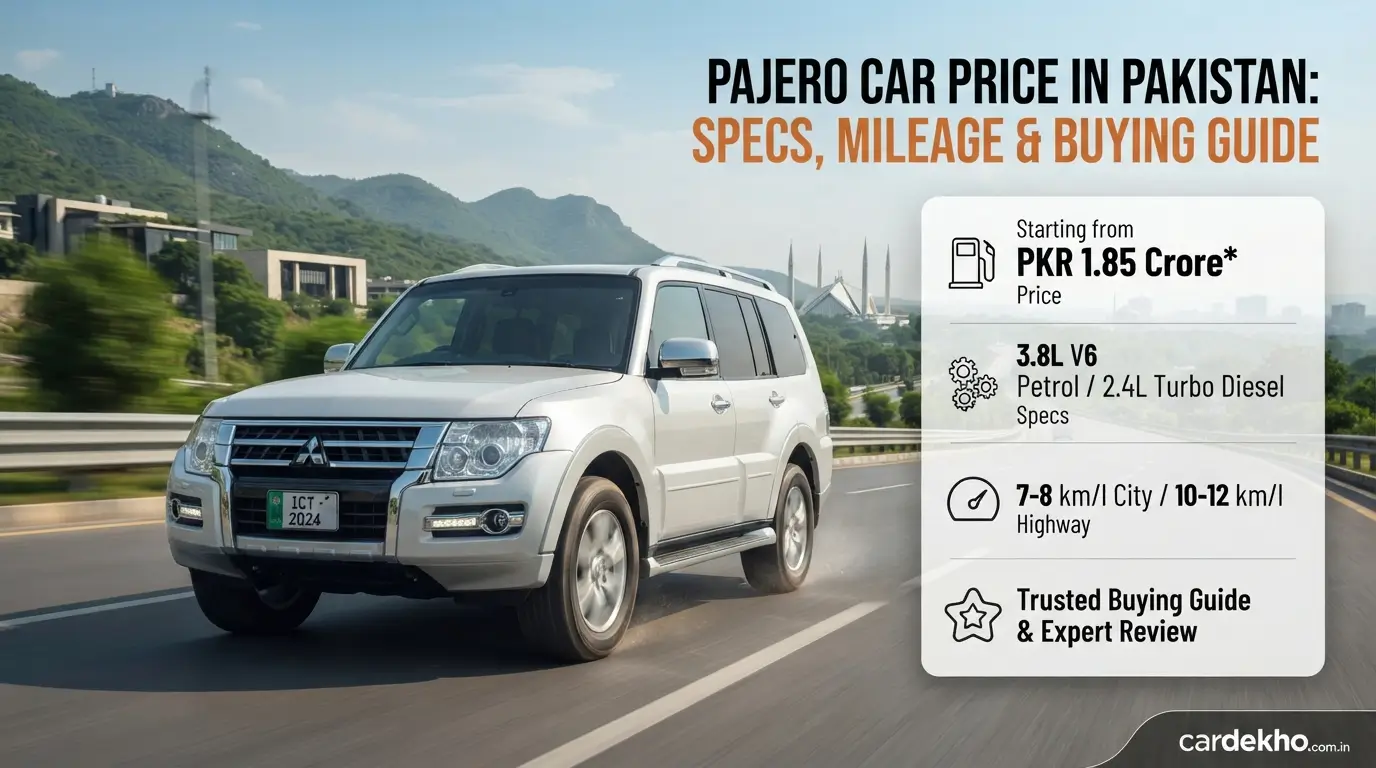
Welcome to CarDekho. The Pajero car is a well-known Mitsubishi SUV valued for its rugged design, four-wheel-drive capability, spacious cabin, and off-road performance. In Pakistan, most buyers encounter the Pajero in the used-car market, where prices and specifications vary considerably by generation, engine, variant, mileage, and condition.
For anyone considering a Pajero car, understanding its price, fuel average, specifications, features, maintenance needs, and 4WD system is important. This guide covers the key information buyers need, from basic specifications to a practical used-car inspection checklist.
Pajero Car Price in Pakistan
The price of a Pajero car in Pakistan varies according to its model year, generation, variant, mileage, engine, and overall condition. Used-market prices can differ significantly between older and newer models. Current PakWheels listings show fourth-generation Pajero models at approximately PKR 16.5 lakh to PKR 67.5 lakh, while first-generation examples are listed around PKR 11.75 lakh to PKR 12.90 lakh. Second-generation models can range from about PKR 21.77 lakh to PKR 28.10 lakh, showing how strongly generation and vehicle condition influence the used car price.
Factors That Affect Pajero Car Price
Several factors can change the market value of a pajero car:
- Model year and generation
- Petrol or diesel engine
- Variant and equipment level
- Mileage and service history
- Body and interior condition
- Accident or repair history
- Registration and import documentation
- Condition of the engine, transmission, suspension, and 4WD system
The model year and generation usually have a major effect on price because newer versions generally offer updated designs, features, and mechanical improvements. Engine type and variant also matter, as buyers may value certain petrol, diesel, or higher-equipment versions differently.
Mileage and maintenance history are equally important when evaluating a Pajero car. A vehicle with lower mileage, a clean body, proper service records, and a healthy engine and 4WD system can command a higher price than another Pajero of the same year. Buyers should therefore compare the complete condition and history of the vehicle rather than relying only on its asking price.
Pajero Car Specifications
The Pajero car has been offered with different engines and specifications across its generations. Current fourth-generation listings include petrol and diesel engines from around 2,972cc to 3,200cc, with reported output of 177–189 hp and 261–441 Nm of torque. Ground clearance is listed at 225 mm, while seating varies by version.
| Specification | Pajero |
| Body Type | SUV |
| Engine Options | Petrol and Diesel |
| Engine Capacity | Approx. 2,972–3,200cc in listed 4th-gen versions |
| Transmission | Automatic in listed 4th-gen versions |
| Horsepower | 177–189 hp |
| Torque | 261–441 Nm |
| Ground Clearance | 225 mm |
| Seating | 5–7 persons, depending on variant |
| Drive System | 4WD on applicable variants |
| Fuel Average | About 6–9 km/L in listed versions |
Specifications can differ significantly between generations and variants, so buyers should verify the exact model before purchasing.
Pajero Engine and Transmission Options
The Pajero has been offered with both petrol and diesel engines. Older generations also had manual transmissions, while later versions include automatic options.
Petrol engines can provide smooth performance, while diesel versions are often considered by buyers who prioritize torque and long-distance utility. The right choice depends on the vehicle’s condition, expected usage, fuel budget, and availability of qualified mechanics.
Pajero Car Fuel Average
Fuel economy is an important factor when choosing a Pajero car, especially because it is a large SUV with relatively powerful engines. PakWheels lists an approximate fuel average of 6–7 km/L in the city and 8–9 km/L on the highway for the Pajero. However, actual mileage can vary depending on the engine, transmission, fuel type, driving conditions, and overall vehicle condition.
| Driving Condition | Approx. Fuel Average |
| City | 6–7 km/L |
| Highway | 8–9 km/L |
Older versions may deliver different mileage depending on their engine and mechanical condition. For example, the first-generation Pajero is listed at around 8–10 km/L. Factors such as tyre pressure, engine tuning, traffic, air-conditioning, vehicle load, and transmission condition can further affect the real-world fuel economy of a Pajero car.
Pajero Generations and Variants
The Pajero car has developed through several generations, with changes in design, engines, features, and technology. The first generation was a more basic SUV and was offered with petrol and diesel engines, along with manual and automatic transmissions. The second generation expanded the engine range with options such as 2.4-litre petrol, 2.8-litre diesel, and 3.5-litre petrol versions.
The third generation introduced a more updated design and additional engine choices, including the GDI 3.5L petrol and GLS 2.8D diesel variants. The fourth generation brought newer styling and equipment, with listed options including 3.0-litre petrol and 3.2-litre diesel engines. Buyers may also come across GLX, GLS, Exceed, GR, and VR variants, but their features and availability can differ by generation and market.
Pajero Car Features and Interior
The Pajero car offers a practical SUV interior, although features vary by generation, model year, and variant. Depending on the version, buyers may find power windows, power mirrors, alloy wheels, airbags, ABS, traction control, sunroofs, and other convenience features. Newer models generally have a more modern cabin, while older versions focus more on simple, durable functionality.
Comfort and Practicality
A Pajero car provides useful cabin space for family trips, long journeys, and outdoor travel. Depending on the variant, seating can range from five to seven passengers, while some versions use a three-door layout. Buyers should check the actual seating arrangement, seat condition, air conditioning, dashboard, and storage space before purchasing a used model.
It is also important to inspect the cabin for signs of heavy use or poor maintenance. Working controls, clean upholstery, effective cooling, and a well-kept interior can indicate better overall ownership condition and help buyers avoid unexpected repair costs.
Safety Features
Safety equipment in a Pajero car depends on the specific generation and variant. Available features can include airbags, ABS, and traction control, while newer versions may offer additional safety technology.
Buyers should verify the equipment installed in the actual vehicle instead of assuming that every Pajero has the same safety features. Checking the condition of airbags, warning lights, ABS operation, and other safety systems is especially important when purchasing a used SUV.
Read also: Chevrolet Car In Pakistan: Models, Prices, Specs & Buying Guide
Pajero Car Performance and 4WD Capability
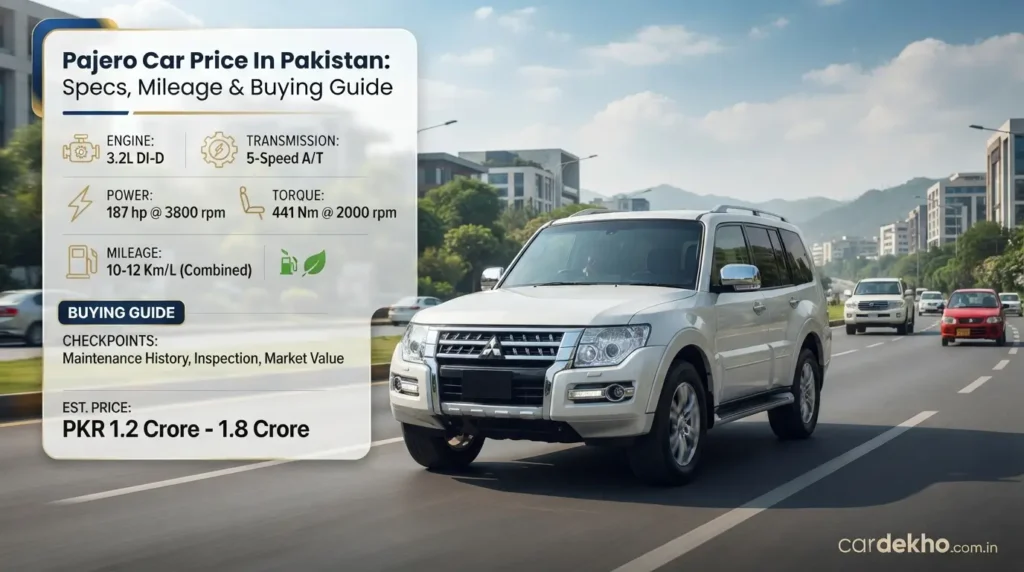
The pajero car is known for its 4WD capability and ability to handle both paved roads and rough terrain. Its ground clearance, engine torque, four-wheel-drive system, and SUV construction make it suitable for challenging roads when properly maintained. Listed fourth-generation models offer around 225 mm of ground clearance, while road performance depends mainly on the engine and transmission. For off-road use, the condition of the drivetrain, suspension, tyres, and 4WD components is equally important.
Is Pajero Good for Off-Road Driving?
Yes, the pajero car is designed for off-road use and can handle rough and uneven terrain when its mechanical systems are in good condition. However, a used Pajero with worn suspension, damaged drivetrain parts, poor tyres, or an unreliable 4WD system may not deliver the expected performance.
Before buying a Pajero car for off-road driving, test the 4WD system and inspect the drivetrain, suspension, tyres, and related components. A qualified mechanic can also identify problems that may not be obvious during a normal test drive.
Pajero Car Maintenance and Spare Parts
Maintaining a pajero car requires regular attention to the engine, transmission, suspension, brakes, cooling system, electrical components, and 4WD system. Older models may need more repairs because of age, previous usage, and wear, so service history is important when evaluating a used vehicle. Regular inspections can help identify problems before they become expensive repairs.
Spare-parts availability can vary by Pajero generation, model year, and variant. Before buying an older or less common model, it is useful to confirm the availability and cost of important parts and find a reliable mechanic familiar with Mitsubishi SUVs. Pakistani automotive marketplaces also list Pajero spare parts, giving buyers additional options for sourcing components.
Things to Check Before Buying a Used Pajero Car
A detailed inspection can help identify expensive problems before purchasing a used pajero car.
Mechanical Inspection
Check:
- Engine smoke and unusual sounds
- Oil or coolant leaks
- Transmission shifts
- Engine temperature
- Suspension noise
- Brake condition
- Steering response
- 4WD engagement
- Differential and drivetrain condition
Documentation and History
Review the vehicle’s registration, import documents where applicable, service records, ownership history, and accident history.
Also compare the odometer reading with the vehicle’s overall condition. Excessive wear on the steering wheel, pedals, seats, and controls can justify a closer inspection of the claimed mileage.
Test Drive Checklist
During a test drive, start the vehicle from cold if possible. Observe the engine, transmission, brakes, steering, suspension, and temperature gauge.
Test the vehicle at different speeds and listen for unusual sounds. If the Pajero has 4WD, verify that the system engages correctly according to the manufacturer’s operating procedure.
Pajero Car vs Other SUVs in Pakistan
The pajero car can be compared with other SUVs in Pakistan based on price, engine options, fuel consumption, maintenance, cabin space, and 4WD capability.
| Factor | Pajero | Toyota Prado | Toyota Fortuner |
| Used-market availability | Generation dependent | Generally established | Broad |
| Engine options | Petrol and diesel | Model dependent | Model dependent |
| 4WD availability | Available on relevant variants | Available on relevant variants | Available on relevant variants |
| Fuel economy | Variant dependent | Variant dependent | Variant dependent |
| Maintenance | Model and condition dependent | Model dependent | Model dependent |
| Parts availability | Varies by generation | Generally established | Generally established |
Pajero vs Toyota Prado
The Pajero and Toyota Prado are both associated with four-wheel-drive SUV use, but their prices, generations, engine choices, equipment, and ownership costs can differ.
For a used purchase, comparing specific model years and variants is more useful than comparing the badges alone.
Pajero vs Toyota Fortuner
The Pajero and Toyota Fortuner differ in age, design, engine choices, market availability, and pricing. A buyer should compare vehicles from similar model years and consider fuel consumption, maintenance history, features, and intended use.
- Pajero Car Pros and Cons
| Advantages of Pajero Car | Disadvantages of Pajero Car |
| Strong 4WD capability | Relatively high fuel consumption |
| Practical SUV body | Older models may need more maintenance |
| Petrol and diesel engine choices | Spare-parts availability can vary |
| Good ground clearance on applicable models | Used-car condition can differ greatly |
| Suitable for long-distance and rough-road driving | Some older variants have limited modern technology |
| Multiple generations and variants in the used market | — |
Is Pajero Car a Good Choice for You?
A pajero car can suit buyers who want an SUV with 4WD capability, good cabin space, and strong rough-road performance. It may also appeal to those looking for an older Japanese SUV with petrol or diesel engine options.
The right choice depends on the condition of the individual vehicle. Before buying, check its service history, drivetrain, and overall condition. Set a realistic maintenance budget and get a professional pre-purchase inspection to identify possible repair costs.
Frequently Asked Questions About Pajero Car
What is the price of a Pajero car in Pakistan?
Current used-market prices vary considerably by generation, year, variant, mileage, and condition. PakWheels currently lists fourth-generation Pajero prices from approximately PKR 16.5 lakh to PKR 67.5 lakh.
What is the fuel average of a Pajero car?
Listed figures are approximately 6–7 km/L in the city and 8–9 km/L on the highway for the covered Pajero variants. Actual fuel average depends on the engine, vehicle condition, traffic, and driving style.
Is the Pajero available with a diesel engine?
Yes. The pajero car has been offered with diesel engines in several generations and variants, including 2.8D and 3.2D examples listed in Pakistan.
Is the Pajero good for off-road driving?
The Pajero has a 4WD-oriented design and suitable ground clearance on relevant variants, making it capable of off-road use. However, the condition of the tyres, suspension, drivetrain, and 4WD system is critical on a used vehicle.
What should I check before buying a used Pajero?
Inspect the engine, transmission, suspension, brakes, cooling system, electrical components, 4WD system, body condition, documentation, service history, and accident history. A professional inspection is advisable before purchase.
Conclusion
The pajero car remains an interesting option in Pakistan’s used SUV market because of its 4WD capability, different engine choices, spacious design, and off-road-oriented character. However, prices and ownership requirements vary significantly between generations and individual vehicles.
Before buying a Pajero car, compare the exact variant, check its fuel average, inspect the mechanical condition, and verify its service and ownership history. For an older SUV, the condition of the individual vehicle can be more important than the model name itself.
