


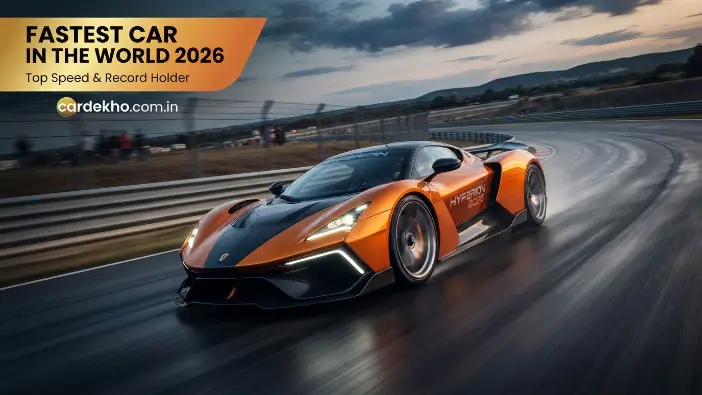
Welcome to CarDekho. The fastest car in the world is the YANGWANG U9 Xtreme, an electric hypercar that reached a verified top speed of 496.22 km/h (308.3 mph). The record was achieved at the ATP Automotive Testing Papenburg facility in Germany, putting the U9 Xtreme just short of the 500 km/h milestone. The record was achieved in September 2025 at the ATP Papenburg test facility in Germany. The U9 Xtreme is based on the YANGWANG U9 electric hypercar and was developed specifically to deliver extreme performance.
This achievement also marks a major shift in the world of extreme-performance cars. For years, petrol-powered hypercars dominated the top-speed race, but the YANGWANG U9 Xtreme has demonstrated how electric power, advanced aerodynamics, specialized tires, and high-voltage technology can push a production car to unprecedented speeds. It is important to distinguish this record from claimed speeds, prototypes, and track-only vehicles. The definition of “fastest car” can change depending on whether the comparison involves production cars, race cars, prototypes, or one-off vehicles.
What Is the Fastest Car in the World?
The YANGWANG U9 Xtreme currently holds the production-car top-speed record, with a verified speed of 496.22 km/h (308.3 mph). The record was achieved in September 2025 at the ATP Papenburg test facility in Germany. The U9 Xtreme is based on the YANGWANG U9 electric hypercar and was developed specifically to deliver extreme performance. Its four-motor electric powertrain, high-voltage electrical architecture, aerodynamic design, and specialized high-speed tires work together to make the car capable of approaching 500 km/h. It is important to distinguish this record from claimed speeds, prototypes, and track-only vehicles. The definition of “fastest car” can change depending on whether the comparison involves production cars, race cars, prototypes, or one-off vehicles.
YANGWANG U9 Xtreme Top Speed
The YANGWANG U9 Xtreme reached 496.22 km/h, equivalent to approximately 308.3 mph. The run took place on the high-speed oval at ATP Papenburg, where manufacturers can conduct controlled high-speed testing. Reaching this speed requires far more than simply installing a powerful engine or electric motor. Aerodynamic stability, tire capability, power delivery, gearing, battery performance, and track conditions all become critical.
The achievement puts the U9 Xtreme within striking distance of the symbolic 500 km/h barrier. The U9 Xtreme is based on the YANGWANG U9 electric hypercar and was developed specifically to deliver extreme performance. Its four-motor electric powertrain, high-voltage electrical architecture, aerodynamic design, and specialized high-speed tires work together to make the car capable of approaching 500 km/h. It is important to distinguish this record from claimed speeds, prototypes, and track-only vehicles. The definition of “fastest car” can change depending on whether the comparison involves production cars, race cars, prototypes, or one-off vehicles.
Why the U9 Xtreme Is So Fast
The U9 Xtreme uses four electric motors, allowing power to be delivered independently to each wheel. This configuration provides extremely rapid torque delivery and precise control over the car’s behavior. Its 1,200-volt electrical architecture is also designed for extreme performance. At nearly 500 km/h, the car must overcome enormous aerodynamic resistance, meaning substantial power is required simply to continue accelerating.
The car’s aerodynamics and high-speed tires are equally important. At these speeds, even small changes in aerodynamic balance or tire behavior can have serious consequences, making high-speed stability one of the biggest engineering challenges. The U9 Xtreme is based on the YANGWANG U9 electric hypercar and was developed specifically to deliver extreme performance. Its four-motor electric powertrain, high-voltage electrical architecture, aerodynamic design, and specialized high-speed tires work together to make the car capable of approaching 500 km/h.
Bugatti Chiron Super Sport 300+
The Bugatti Chiron Super Sport 300+ became famous for breaking the 300-mph barrier. Bugatti recorded a speed of 490.484 km/h (304.77 mph) during its high-speed run. Its achievement was particularly significant because it demonstrated that a road-car-based hypercar could exceed 300 mph. The car uses a heavily engineered petrol powertrain and aerodynamic body designed for high-speed stability.
Although the Chiron Super Sport 300+ has now been surpassed by the YANGWANG U9 Xtreme in absolute production-car top speed, it remains one of the most important cars in modern top-speed history. The U9 Xtreme is based on the YANGWANG U9 electric hypercar and was developed specifically to deliver extreme performance. Its four-motor electric powertrain, high-voltage electrical architecture, aerodynamic design, and specialized high-speed tires work together to make the car capable of approaching 500 km/h.
How the Record Has Changed
The race for higher top speeds has evolved from powerful combustion engines toward increasingly sophisticated electric powertrains. The progression from 300 mph toward 310 mph is particularly demanding because aerodynamic drag rises dramatically with speed. A car capable of 300 mph cannot simply add a small amount of power and expect to reach 310 mph. At these speeds, engineers must simultaneously manage aerodynamic drag, tire loads, drivetrain heat, stability, and power delivery.
The U9 Xtreme is based on the YANGWANG U9 electric hypercar and was developed specifically to deliver extreme performance. Its four-motor electric powertrain, high-voltage electrical architecture, aerodynamic design, and specialized high-speed tires work together to make the car capable of approaching 500 km/h. It is important to distinguish this record from claimed speeds, prototypes, and track-only vehicles. The definition of “fastest car” can change depending on whether the comparison involves production cars, race cars, prototypes, or one-off vehicles.
Read Also: Benz Car in Pakistan: Prices, Models & Complete Buying Guide
Fastest Electric Car vs Fastest Petrol Car
Electric and petrol hypercars approach extreme speed in very different ways. The U9 Xtreme is based on the YANGWANG U9 electric hypercar and was developed specifically to deliver extreme performance. Its four-motor electric powertrain, high-voltage electrical architecture, aerodynamic design, and specialized high-speed tires work together to make the car capable of approaching 500 km/h. It is important to distinguish this record from claimed speeds, prototypes, and track-only vehicles. The definition of “fastest car” can change depending on whether the comparison involves production cars, race cars, prototypes, or one-off vehicles.
Fastest Electric Production Car
The YANGWANG U9 Xtreme currently leads the production-car top-speed category with its 496.22 km/h record. Its electric powertrain provides immediate torque and allows four motors to work together. Electric torque can be precisely controlled at each wheel, giving engineers additional tools for managing traction and stability. The U9 Xtreme therefore represents more than another high-performance EV. Its record demonstrates that electric propulsion can compete directly with the world’s most extreme combustion-powered hypercars in top-speed performance.
The U9 Xtreme is based on the YANGWANG U9 electric hypercar and was developed specifically to deliver extreme performance. Its four-motor electric powertrain, high-voltage electrical architecture, aerodynamic design, and specialized high-speed tires work together to make the car capable of approaching 500 km/h. It is important to distinguish this record from claimed speeds, prototypes, and track-only vehicles. The definition of “fastest car” can change depending on whether the comparison involves production cars, race cars, prototypes, or one-off vehicles.
Fastest Petrol-Powered Production Car
The Bugatti Chiron Super Sport 300+ reached 490.484 km/h (304.77 mph) during its record-setting run. The achievement came from a combination of enormous engine output, aerodynamic optimization, high-speed gearing, specialized tires, and extensive engineering. It remains one of the defining achievements of petrol-powered hypercar development.
The U9 Xtreme is based on the YANGWANG U9 electric hypercar and was developed specifically to deliver extreme performance. Its four-motor electric powertrain, high-voltage electrical architecture, aerodynamic design, and specialized high-speed tires work together to make the car capable of approaching 500 km/h. It is important to distinguish this record from claimed speeds, prototypes, and track-only vehicles. The definition of “fastest car” can change depending on whether the comparison involves production cars, race cars, prototypes, or one-off vehicles.
Which Is Faster?
Based on the verified production-car records discussed here, the YANGWANG U9 Xtreme is faster. Its 496.22 km/h record is approximately 5.74 km/h higher than the Bugatti Chiron Super Sport 300+’s 490.484 km/h figure. However, top speed is only one measure of automotive performance. Acceleration, braking, cornering, lap times, thermal management, and everyday usability can all produce very different performance rankings.
The U9 Xtreme is based on the YANGWANG U9 electric hypercar and was developed specifically to deliver extreme performance. Its four-motor electric powertrain, high-voltage electrical architecture, aerodynamic design, and specialized high-speed tires work together to make the car capable of approaching 500 km/h. It is important to distinguish this record from claimed speeds, prototypes, and track-only vehicles. The definition of “fastest car” can change depending on whether the comparison involves production cars, race cars, prototypes, or one-off vehicles.
How Does a Car Reach Nearly 500 km/h?
Reaching almost 500 km/h requires the entire vehicle to be engineered around high-speed performance. Power alone is not enough. The U9 Xtreme is based on the YANGWANG U9 electric hypercar and was developed specifically to deliver extreme performance. Its four-motor electric powertrain, high-voltage electrical architecture, aerodynamic design, and specialized high-speed tires work together to make the car capable of approaching 500 km/h. It is important to distinguish this record from claimed speeds, prototypes, and track-only vehicles. The definition of “fastest car” can change depending on whether the comparison involves production cars, race cars, prototypes, or one-off vehicles.
Aerodynamics
Aerodynamic drag is one of the biggest challenges when a car reaches very high speeds. As speed increases, the air pushes harder against the vehicle, requiring much more power to keep accelerating. Engineers design the body to move through the air as smoothly as possible, reducing resistance while keeping the car stable.
However, reducing drag is not the only goal. The car also needs enough downforce and aerodynamic stability to remain firmly controlled at extreme speeds. A top-speed hypercar therefore needs a careful balance between low drag and stability, while a race car designed mainly for cornering may use more downforce even if it reduces its maximum speed.
Engine or Motor Power
The faster a car travels, the more power it needs to overcome air resistance. At extremely high speeds, aerodynamic drag becomes a major obstacle, so the engine or electric motors must produce enough power to keep accelerating. This is why achieving a top speed of nearly 500 km/h requires far more than simply having a powerful drivetrain.
Electric motors deliver instant torque, which helps a car accelerate quickly and maintain strong power delivery. Petrol engines, meanwhile, can produce sustained high-speed power through advanced engines, transmissions, and gearing. Both systems also generate significant heat at extreme speeds, making effective cooling and reliable drivetrain components essential.
Tires and Stability
Tires play a critical role in determining how fast a car can safely travel. At nearly 500 km/h, the tires rotate at an extremely high rate, creating enormous centrifugal forces that try to pull the tire apart. They also generate significant heat and must handle the weight of the car, aerodynamic forces, road contact, and rapid changes in temperature. Even a small tire defect or loss of stability can become extremely dangerous at this speed.
High-speed tires therefore require specialized materials, construction, and testing. Engineers carefully design the tire’s internal structure and tread to remain stable under extreme loads while maintaining enough grip on the track. Before a hypercar attempts its maximum speed, the tires must be tested under controlled conditions and matched to the vehicle’s suspension, aerodynamics, and power delivery. This is why a car’s theoretical top speed does not mean it can safely achieve that speed on a normal road.
Testing Conditions
Top-speed records are achieved on specially designed test tracks rather than public roads. These facilities provide long, smooth surfaces where a car can safely build up extreme speed and then slow down. Engineers also control factors such as track conditions, weather, tire performance, and vehicle setup to reduce risks during the test.
Specialized equipment is used to measure and verify the car’s actual speed. Engineers monitor the vehicle throughout the run, checking its stability, tire condition, power delivery, and other critical systems. This controlled approach helps ensure that a top-speed record is accurately measured and achieved under safe, repeatable conditions.
Common Misconceptions About the Fastest Car
There are several misconceptions about what makes a car the fastest car in the world. Many people assume that the car with the highest claimed top speed is automatically the fastest, but that is not always true. Some speed figures come from prototypes, modified vehicles, or special testing conditions rather than a standard production car. It is therefore important to check whether the speed has been officially verified and whether the vehicle qualifies as a production car. Another common mistake is confusing top speed with overall performance. A car that can reach an extremely high speed in a straight line may not be the fastest around a racetrack. Track performance also depends on acceleration, braking, cornering, tires, aerodynamics, and handling.
Is the Fastest Car Always the Fastest Around a Track?
No. The car with the highest top speed is not necessarily the fastest car around a racetrack. Top speed measures how quickly a car can travel in a straight line, while a track lap tests many other aspects of performance, including acceleration, braking, cornering, aerodynamics, tire grip, and handling.
For example, a hypercar designed mainly for maximum top speed may produce less downforce to reduce aerodynamic drag. A track-focused car may have a lower top speed but generate much more downforce, allowing it to corner and brake at higher speeds. As a result, a car with a lower top speed can complete a race track faster than a car with a higher top speed.
Does a Claimed Top Speed Count as a Record?
Not automatically. A claimed top speed becomes meaningful only when the test is properly documented, and the vehicle’s speed is accurately measured. A credible record should provide details about the test location, conditions, measurement method, and vehicle category. This makes it easier to separate a verified record from a manufacturer’s performance claim.
Some manufacturers may achieve impressive speeds using prototypes, pre-production vehicles, or specially modified versions of a car. These vehicles may not be identical to the production models available to customers. For this reason, verified production-car records provide a more reliable and straightforward way to compare the world’s fastest cars.
Can You Drive at 496 km/h on a Public Road?
No. A speed of 496 km/h is an extreme test-track achievement and is not a practical or safe speed for normal road driving. At this speed, the car faces enormous aerodynamic forces, while the tires, brakes, suspension, and drivetrain must operate under extreme stress. Even small changes in road conditions or vehicle stability can have serious consequences.
Reaching such a speed requires a specially prepared high-speed test facility, suitable road surfaces, specialized tires, professional engineers, and extensive safety measures. The vehicle must also have enough space to accelerate and safely slow down after reaching its maximum speed. This is why the 496 km/h record should be viewed as an engineering achievement rather than a speed that can be safely attempted on public roads.
What Makes the YANGWANG U9 Xtreme Different?
The U9 Xtreme’s biggest distinction is the combination of electric propulsion and extreme top-speed engineering. Its four-motor configuration gives the car substantial power and precise control over torque distribution. Its high-voltage architecture is designed to support the electrical demands of extreme performance. The record is also significant because it shows how quickly electric hypercars have developed.
Earlier electric vehicles were often associated primarily with instant acceleration, while top speed remained an area dominated by high-output petrol hypercars. The U9 Xtreme challenges that assumption by approaching 500 km/h in a production-car context. Its record also highlights an important trend in the hypercar industry: manufacturers are increasingly using software, electric motors, advanced materials, aerodynamics, and sophisticated control systems alongside raw power to achieve extreme performance.
Frequently Asked Questions
What is the fastest car in the world?
The YANGWANG U9 Xtreme currently holds the production-car top-speed record discussed in this article, reaching 496.22 km/h (308.3 mph).
What is the top speed of the fastest car?
The verified top speed is 496.22 km/h, or approximately 308.3 mph.
Is the fastest car electric?
Yes. The YANGWANG U9 Xtreme is an electric hypercar powered by four electric motors.
What was the fastest car before the YANGWANG U9 Xtreme?
The Bugatti Chiron Super Sport 300+ achieved 490.484 km/h (304.77 mph) during its record-setting high-speed run and was one of the defining benchmarks before the U9 Xtreme’s production-car record.
Is 500 km/h possible for a production car?
The U9 Xtreme’s 496.22 km/h record shows that the industry is extremely close to the 500 km/h threshold. Reaching and verifying 500 km/h in a production-car category will require continued advances in power, aerodynamics, tires, cooling, and high-speed stability.
Conclusion
The fastest car in the world is currently the YANGWANG U9 Xtreme, which reached a verified top speed of 496.22 km/h (308.3 mph). This achievement is important because reaching such a speed requires much more than a powerful drivetrain. The car must maintain stability while dealing with enormous aerodynamic forces, extreme tire loads, intense heat, and the constant demands placed on its electric motors and high-voltage system. Its record demonstrates how advanced aerodynamics, electric power, specialized tires, and sophisticated vehicle control systems have come together to push production-car performance to a new level.
The U9 Xtreme also represents a major change in the traditional hypercar top-speed competition. For years, petrol-powered cars such as the Bugatti Chiron Super Sport 300+ dominated the highest-speed category, but the U9 Xtreme has now moved the benchmark beyond 490 km/h. With only a small gap remaining to 500 km/h, manufacturers face an increasingly difficult engineering challenge. Breaking that barrier will require improvements in power delivery, aerodynamic efficiency, tire technology, cooling, and high-speed stability, making the next record one of the most demanding achievements in modern automotive engineering.
